Some More Readings for Our Eleventh Meeting — PHOTOGRAPHY

MONDAY, MARCH 28, 2016

Hi Old New Wayers,

For the meeting on Wednesday night, I would like everybody (who can make it) to bring at least one photo or image with you.

(Yes, it can be on a screen, so long as we can pass it around!)

Bring something that either:

  1. Strikes you as beautiful or artistic in some way, or
  2. Represents something important or meaningful to you (that is, even if it is not “beautiful or artistic”).

I would love to talk about the role of photos and images in our lives (including Instagram, Facebook, family photos, etc.).

Do they bring us meaning? How do they interfere with it?

Why are we compelled to represent the rush of our lives in a static form? How does it interact with our natural ways of remembering? What do you like to look at in photographs, and why?

Lots of interesting questions that we all ponder sometimes. It will be useful, I think, to examine them together.

*

Also, if you scroll down to the bottom of our Reading for Our Eleventh Meeting on March 30, 2016 — PHOTOGRAPHY  post, and you will find two videos worth watching. One is a TED talk by JR (suggested by Kristen), the other is a link to John Berger, Ways of Seeing (suggested by Marie-José).

*

An artist friend, Jessie Thatcher, submitted the following essay by Agnes Martin:

Beauty Is the Mystery of Life
by Agnes Martin
When I think of art, I think of beauty. Beauty is the mystery of
life. It is not in the eye, it is in my mind. In our minds there
is awareness of perfection.
We respond to beauty with emotion. Beauty speaks a message to
us. We are confused about this message because of distractions.
Sometimes we even think that it is in the mail. The message is
about different kinds of happiness and joy. Joy is most
successfully represented in Beethoven's Ninth Symphony and by
the Parthenon.
All artwork is about beauty; all positive work represents it and
celebrates it. All negative art protests the lack of beauty in
our lives. When a beautiful rose dies, beauty does not die
because it is not really in the rose. Beauty is an awareness in
the mind. It is a mental and emotional response that we make. We
respond to life as though it were perfect. When we go into a
forest we do not see the fallen rotting trees. We are inspired
by a multitude of uprising trees. We even hear a silence when it
is not really silent. When we see a newborn baby we say it is
beautiful – perfect.
The goal of life is happiness and to respond to life as though
it were perfect is the way to happiness. It is also the way to
positive artwork.
It is not in the role of an artist to worry about life – to feel
responsible for creating a better world. This is a very serious
distraction. All your conditioning has been directed toward
intellectual living. This is useless in artwork. All human
knowledge is useless in artwork. Concepts, relationships,
categories, classifications, deductions are distractions of mind
that we wish to hold free for inspiration.
There are two parts of the mind. The outer mind that records
facts and the inner mind that says "yes" and "no." When you
think of something that you should do, the inner mind says "yes"
and you feel elated. We call this inspiration.
For an artist this is the only way. There is no help anywhere.
He must listen to his own mind.
The way of the artist is an entirely different way. It is a way
of surrender. He must surrender to his own mind.
When you look in your mind you find it covered with a lot of
rubbishy thoughts. You have to penetrate these and hear what
your mind is telling you to do. Such work is original work. All
other work made from ideas is not inspired and is not artwork.
Artwork is responded to with happy emotions. Work about ideas is
responded to with other ideas. There is so much written about
art that it is mistaken for an intellectual pursuit.
It is quite commonly thought that the intellect is responsible
for everything that is made and done. It is commonly thought
that everything that is can be put into words. But there is a
wide range of emotional response that we make that cannot be put
into words. We are so used to making these emotional responses
that we are not consciously aware of them until they are
represented in artwork.
Out emotional life is really dominant over our intellectual
life, but we do not realize it.
You must discover the artwork that you like, and realize the
response that you make to it. You must especially know the
response that you make to your own work. It is in this way that
you discover your direction and the truth about yourself. If you
do not discover your response to your own work, you miss the
reward. You must look at the work and know how it makes you
feel.
If you are not an artist, you can make discoveries about
yourself by knowing your response to work that you like.
Ask yourself, What kind of happiness do I feel with this music
or this picture?
There is happiness that we feel without any material
stimulation. We may wake up in the morning feeling happy for no
reason. Abstract or nonobjective feelings are a very important
part of our lives. Personal emotions and sentimentality are
anti-art.
We make artwork as something that we have to do, not knowing how
it will work out. When it is finished we have to see if it is
effective. Even if we obey inspiration we cannot expect all the
work to be successful. An artist is a person who can recognize
failure.
If you were a composer you would not expect everything you
played to be a composition. It iss the same in the graphic arts.
There are many failures.
Artwork is the only work in the world that is unmaterialistic.
All other work contributes to human welfare and comfort. You can
see from this that human welfare and comfort are not the
interests of the artist. He is irresponsible because his life
goes in a different direction. His mind will be involved with
beauty and happiness. It is possible to work at something other
than art and maintain this state of mind and be moving ahead as
an artist. The unmaterial interest is essential.
The newest trend and the art scene are unnecessary distractions
for a serious artist. He will much more rewarded responding to
art of all times and places – not as art history but considering
each piece and its value to him.
You can't think, My life is more important than the work, and
get the work. You have to think the work is paramount in your
life. An artist's life is adventurous: one new thing after
another.
I have been talking directly to artists, but it applies to all.
Take advantage of the awareness of perfection in your mind. See
perfection in everything around you. See if you can discover
your true feelings when listening to music. Make happiness your
goal. The way to discover the truth about this life is to
discover yourself. Say to yourself, What do I like and what do I
want? Find out exactly what you want in life. Ask your mind for
inspiration about everything.
Beauty illustrates happiness: the wind in the grass, the
glistening waves following each other, the flight of birds – all
speak of happiness.
The clear blue sky illustrates a different kind of happiness,
and the soft dark night a different kind. There are an infinite
number of different kinds of happiness.
The response is the same for the observer as it is for the
artist. The response to art is the real art field.
Composition is an absolute mystery. It is dictated by the mind.
The artist searchers for certain sounds or lines that are
acceptable to the mind and finally an arrangement of them that
is acceptable. The acceptable compositions arouse certain
feelings of appreciation in the observer. Some compositions
appeal to some, and some to others.
But if they are not accepted by the artist's mind, they will not
appeal to anyone. Composition and acceptance by mind are
essential to artwork. Commercial art is consciously made to
appeal to the senses, which is different. Artwork is very
valuable and it is also very scarce. It takes a great deal of
application to make a composition that is totally acceptable.
Beethoven's symphonies, with every note composed, represent a
titanic human effort.
To progress in life you must give up the things that you do not
like. Give up doing the things that you do not like to do. You
must find the things that you do like – the things that are
acceptable to your mind.
You can see that you will have to have time to yourself to find
out what appeals to your mind. While you go along with others,
you are not really living your life.
To rebel against others is just as futile. You must find your
way.
Happiness is being on the beam with life – to feel the pull of
life.

*

And finally… for those who don’t have time to get to the readings this week… I wrote up some notes. (I wrote them to try to grope towards some connection between them — still working on that.)

Skim them if you want a (very basic) sense of what was in there.

See you soon!

Tom

*

Some Brief Notes on the Readings

Scruton, BEAUTY: A SHORT INTRODUCTION

He asks, Is beauty an ultimate value? (like Truth, Goodness?)

His answer: it is not the same.

If it were the same, then why would being an “aesthete” be seen as a term of derision?

Why are many people skeptical of over-indulgence in respect to beauty (but not truth or goodness)?

Scruton’s five “platitudes”:

  1. Beauty pleases us.
  2. It is comparative.
  3. It demands attention.
  4. Judgments of taste are about the object being perceived (not merely about the one doing the perceiving)
  5. Still, no convincing proof of beauty or taste is available.

Strange paradox: beauty FEELS objective, yet we cannot convince others of it (if they don’t already agree).

Types of Beauty to think about:

  1. Ecstatic, extreme experiences of it
  2. Everyday experiences of it
  3. The ‘Sublime’
  4. The “Picturesque”
  5. ‘Form follows function,’ i.e. utility (practical arts)
  6. Only for pleasure – “the thing itself” (fine arts)
  7. Sensory element (but not only…)
  8. Abstract / intellectual element (framing)
  9. Disinterested
  10. Interested
  11. Can be expressed in the form of a ‘style’

Scruton argues that mere taste, smell, touch, are not enough to constitute beauty (e.g. wine).

We need some mental part too.

Beauty is experienced in a “presented form.”

Evolutionary explanations for beauty:

  1. Group selection (ritual, shared purposes, etc.)
  2. Individual sexual selection (but is a peacock tail really doing the same work as Bach?)

Certainly beauty is related to desire.

But how so?

It can inspire the desire to possess… a body, an artwork, a piece of jewelry…

But there is also understood to be a Platonic, so-called “higher” form of beauty, which creates a desire not for possession but for contemplation.

Eros is perhaps best described as the act of singling out.

Consider the difference between pornography and (deeper?) beauty of “embodiment.”

Pornography provokes in some the desire to possess. Beauty provokes something quite different… a kind of disinterested state of wonder.

Note that there is a parallel when we turn our gaze to nature.

A sense of the beauty of nature is not the same as a scientific interest in it.

(To know the geology of a cliff is not the same as to marvel at the rocks.)

This feeling of disinterested contemplation became a form of the sacred, as religion receded.

Indeed, art became THE vehicle for beauty in the 19th century, replacing god.

But this has declined in our own era. Beauty is no longer a longed-for experience… Much art is a spectacle, or an attempt to disorient, or a subversive act.

Difference between art that expands our imaginations

and

pseudo-art, which merely entertains, arouses, amuses, or preaches.

Content vs. form

Scruton discusses Van Gogh’s The Yellow Chair.

Distinction between an artists attempt at representation (observable details, concepts) vs. expression (intuitions).

The yellow chair in the painting may be said to express an unseen life, a relationship with objects; or even something that goes beyond what it represents.

One idea: Beauty may be human experience under the aspect of necessity?

Modernism was an attempt to “recuperate” beauty from its mass reproduction and emptying-out in modern world

But now, according to Scruton, our post-modernist (and increasingly nihilistic) culture is more interested in tearing down.

So the most common forms of art are kitsch and irony.

Kitsch is beauty without consequences – everything works out perfectly, no sacrifice.

Irony is beauty without commitment – nothing is sacred, nothing fixed, just the arrangement and juxtaposition of forms.

Susan Sontag, ON PHOTOGRAPHY

(Sontag’s style is very declarative. So I will simply share some of her declarations:)

To photograph is to appropriate the thing photographed.

Photographs are aggressive. Every use of the camera is an act of interpretation.

Photos take possession of a space in which people feel insecure.

They also refuse experience – by limiting it to a search for the photogenic.

They are fantasy machines. They promote nostalgia.

Always the knowledge gained from photographs is a “kind of sentimentalism, whether cynical or humanist.”

Photographs follow Walt Whitman’s erotic embrace of experience in its entirety. (She mentions William Steiglitz,, Diane Arbus.)

In our era, the image is becoming more important than the original.

We have, she claims, a “steadily more complex sense of the real.”

Morris, BELIEVING IS SEEING


This book is too wonderful to summarize.

It examines, through a series of case histories, the way photographs capture events and things but also contain infinite mysteries. What is authentic? What can we ever really know about the subjects of a photograph? What can a photograph do in the world?

Jessie Thatcher’s Photography

WEDNESDAY, MARCH 30, 2016

Jessie is an artist friend (whom I met through Miriam Dym and our shared project, Submit for Riff).

Jessie’s work explores how we see and organize the world visually. She presses against the limits of our narrow primate vision, bending forms, breaking habits, through photographs, drawings, collage.

She took the time to answer the questions I posed when I introduced this topic in Reading for Our Eleventh Meeting on March 30, 2016 — ART: PHOTOGRAPHY.

Here is what she said:

ART: PHOTOGRAPHY.

Can art function as a “religion,” as some people claim?

When I think of religion, I think of rule following and when I think of art, I think of rule breaking. But, there is an implied set of aesthetic rules when making art and an artistic practice could be considered a religious one. I just don’t know…it depends on what your perception of religion is and how you view art. I’m not a religious person, but I guess I do find a type of spirituality in making art and viewing art. I think of art as more of a conversation than a preaching device. Those who want to join into the conversation, that’s welcomed, and it’s also fine if people don’t.

Can a painting, a song, a sculpture, a performance, even a photograph, give us meaning?

Yes, I think so. When I think of the word “meaning” applied to art, I translate the word to “heightened experience.”

As an artist I am constantly asking myself why did I choose this lifestyle, why couldn’t I have chosen a more practical occupation? Is art important?

Through experience we can answer these questions. For instance, the answer to my questions about the meaning of art took an act of walking into a real estate office. I walked into this completely deserted office and developed this strong reaction to this isolated room in space, shocked by its one- dimensionality; the beige walls mix into the brown floors, completely devoid of art, family pictures poorly hung and cheaply printed, there was no aesthetic reflection in this office, unless it was a fascist one. This beige- khaki pants office was the answer to me, this little office was an isolated representation to me of what the world might look like if there wasn’t any art, and it was awful. It was boring and stagnant. I realized then and there that I might not make much money being an artist, but I do live a visually rich life, and to me that adds so much meaning. And by visually rich, I mean, I am actively looking all the time, whether I’m making art, or working a menial job, I am constantly observing and arranging.

What do representations of the natural world do for our particular species of primate, homo sapians?

We are programed to scan our environments very quickly. Just try and focus on one object for more than a second, it’s very hard. Our eye movements are programed to scan quickly and we don’t focus in one area for very long. It’s a human glitch! So yes, I think we do need pictorial references– isolated documents of time–to slow us down, and look. I think the “meaning” or resonance comes along after the fact, it’s when you encounter whatever that artwork was referring to in your daily experience. I think artwork does add meaning to our lives.

Why do we seek them so avidly? Why do they fill us with longing? Make us shiver? Sometimes even change us forever?

I had a “shiver” response once! A couple years back, I visited an Agnes Martin exhibition and the gallery room was filled with all of her pastel line paintings and I got shivers. I’m not sure why I got shivers, but I strongly reacted to that work.

When I think about my process as an artist, it’s primarily a nonverbal process. So it makes sense to me that we have nonverbal reactions to some artworks.

*

Here is a small selection of Jessie’s marvelous work. (You can see more on her website thatcherjessie.com.)

CR1
CR2
CR3

CR4jpeg

“Continuously Recorded”

“The photograph is a thin slice of space as well as time. In a world ruled by photographic borders (“framing”) seem arbitrary. Anything can be separated, can be made discontinuous, from anything else: all that is necessary is to frame the subject differently. (Conversely, anything can be made adjacent to anything else.” Susan Sontag, “On Photography”

“Continuously Recorded” arose from questions about what is a camera and when is the documentation of an image no longer considered photography?

While in school I took a visual communications class, and I remember the instructor saying that there is a “right” way to crop a portrait or person for a film composition, he said, “Don’t crop a portrait mid-eyeball, it’s disturbing.’ That’s what led me into “disturbing” cropping methods and compositions.

In this series I do not use a camera, only a scanner, pencil, and a razor blade. Upon creating this series, I was thinking about the role of the grid in contemporary art; I wanted to reinterpret the grid by dissecting it, and use it as a means to reinterpret the photographic medium. I am deconstructing the grid and using it as a tool to deconstruct the traditional notions of viewing and making an image. As a viewer I want to struggle at what I am seeing. With this body of work, I honestly don’t know how many copies it is from the original work of art? It doesn’t matter. The initial work of art and reproduction becomes raw material for this abstract photographic composition.

— Jessie Thatcher

*

Jessie also pointed us towards this endearing interview with David Hockney, in which he talks about the end of chemical photography with the advent of Photoshop.

Notes on Our Eleventh Meeting — PHOTOGRAPHY

FRIDAY, APRIL 1, 2016

We gathered as usual at 8 pm. In a burst of optimism, I sent my kids upstairs, telling them to get their pajamas on, brush their teeth, and put themselves to bed. By 8:30 we moved into the living room.

1. Tom’s Presentation: What Do Photos Do For Us?

I talked a little about my own bafflement about why I post to Facebook. What is the purpose in my mind? But then I shifted the question to what a photo means to me in a purely private sense.

Yann caught this shift and clarified that… we were no longer talking about social media, then? I took his correction and tried to narrow my point of what a photograph means to each one of us privately.

Still, as our discussion got underway, it all got mixed up anyway!

Setenay remarked that she posts photos online mostly for her family in Turkey to view. So Facebook functions for her a kind of convenient photo-album. She feels that photographs are always nostalgic and sentimental. They are also celebrations, though. But perhaps, she suggested, there is another use of them: as a way to construct meaning in our lives.

Marie-José mentioned that, for her, photographs play a very different role: they simply provide a method by which to capture the unique way she sees the world. For example, she said, she may see two lines intersecting on a light post, or on a store window, and she will snap a quick photograph of that. This happens all day long, little instances when she wants to hold a moment in time. At home, Marie-José confessed, she spends a lot of time organizing and sifting through her digital photos, categorizing them by theme and visual impact.

Kristen said that because photos capture time they give her pleasure — she does not dwell on the loss, or even feel nostalgic, but instead the memories lift her.

I mentioned how the more I have learned about the neural plasticity of our brains, the more suspicious I have become of recorded images. According to neuroscience,  photographs and home videos, once viewed, will dominate our memories whether we want them to or not. Other, more elusive memories will not merely get crowded out or overpowered; they will, in effect, get erased.

For that reason I am glad that I have never watched Renée’s and my wedding video — I want the experience of that day to stay rich and strange in my mind and not get reduced to a single, somewhat arbitrary perspective.

2. Yann’s Question about “Arabic” vs. “Western” Understandings of Photographs

Yann brought up that he has read that in the “Arab” (Muslim?) world art is not understood as a separate realm of beauty and aspiration than crafts. Art is work like any other kind of work. There is shoddy work. There is excellent work. That applies to making a chair. It applies equally to painting a portrait.

In the West we are accustomed to this idea of an artist inhabiting a separate realm — that of the “fine” arts (or so we call it). “Where do members of the group stand on this question?” he asked. “Do you have the “Arabic” view or the “Western” one? Is art more elevated?

A number of people responded that they think of art as just another craft.

I mentioned that for years I have been feeling that the deluge, the vast quantity of art that reaches us now (through the entertainment delivery systems like Netflix and Xfinity, Youtube, etc.) has changed our understanding of what artists do.

Artists are no longer as rarefied as they used to be. Especially young people seem to celebrate all forms of creativity on equal grounds these days. In fact, some time over the past 10 years we have lost the high-brow, low-brow distinction entirely! (For example, a ridiculous but effective clay-mation story on Youtube may be valued as highly as much as a 16th century poem by John Donne. It’s a “whatever works for you” kind of thing.)

Manon spoke up to say that there does seem to be something about making art that is distinct from crafts.

She ran a preschool for many years, and she described for the group how, on occasion, one of the children’s drawing would turn out to be obviously spectacular. Just the right arrangement of colors and textures. A strange thematic unity. A shocking perspective on, say, what a brother looks like, or a dad (in my own family, I always wondered why I looked so dippy in my children’s early drawings — what devastating truth were they seeing to make them draw me like that? But that’s another story).

But these occasional triumphs of form by preschool-aged children are not the same as art, Manon, argued. Art, to her, is qualitatively different when an artist aspires to a great drawing, than when a child stumbles upon it.

Picking up on this point, I asked Yann if it wasn’t true that some singular mind, some unique artistic sensibility, has to be in charge, even in building the non-representational patterns in the mosques of the Middle East. Surely someone instructed the craftsmen (were there, are there, craftswomen?) to use only aqua-blue and yellow tiles in this one section; to broaden the arc here, and hollow out the bricks just so.

So there was a singular mind, then, with a clear vision, behind the “art,” wasn’t there? Even if it is true that it wasn’t and isn’t valued any more highly than a craft. There is a distinction, even if it isn’t recognized.

I said I agreed with Manon that there strikes me as something missing if we abandon the value the West has (at least since the 17th century) placed on the aspirations of the artist to communicate, not merely to decorate.

4. Art as Communication

Walden followed on this by suggesting that art is nothing more than a form of communication. That is its function. This led to a discussion about Aristotle’s Politics, and his point that outside of society, outside of the polis, “man is either a god or a beast.” That a human life only flourishes in a social setting. I described how this insight was a turning point for me when I was studying philosophy. I had entered graduate school looking for my own individual sense of right and wrong; I left looking to define the values of the world as I wanted it to look. (I was influenced by Richard Rorty in this outlook as well.)

3. Photography

The rest of the meeting we spent, with great pleasure, sharing the photos that people brought.

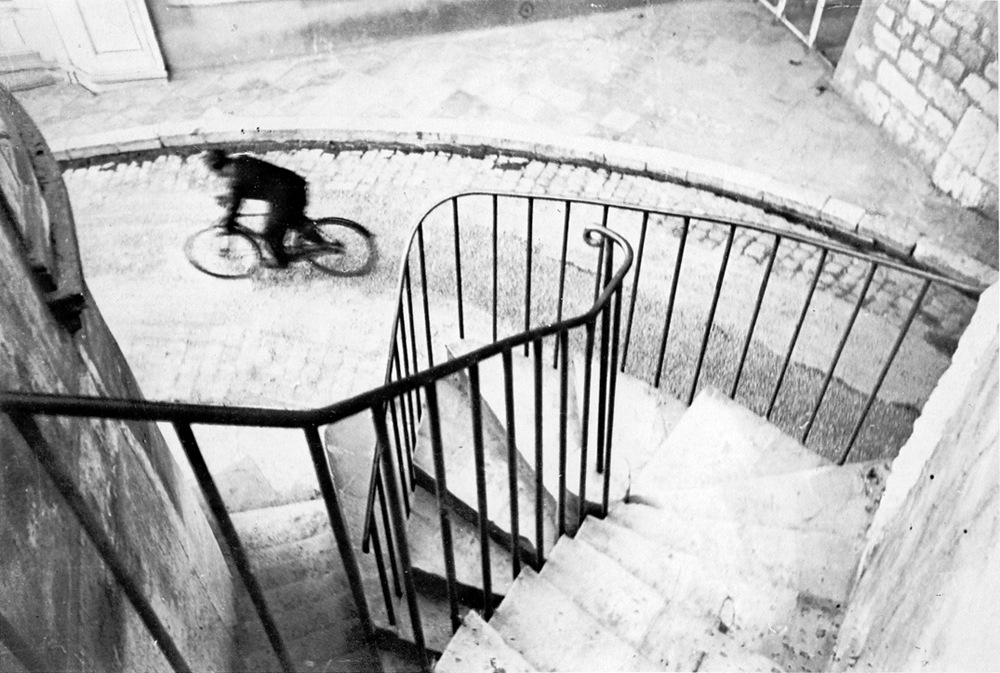
Kristin brought some gorgeous black and white images by the French photographer, Henri Cartier-Bresson, famous for his ability to capture the “decisive moment.” Here are two images Kristen shared:

HenriCartierBresson.HyeresFrance.1932

4ea5e59ca81d2b42b37724973990c96b

Coley showed a photo that she took at the end of summer, two summers ago, on Tomales Bay. She said that she especially like the doubling, even the tripling of the point-of-view in this image, starting with Adeline (our daughter, standing under the tree), then, closer to us, the unseen photographer (Coley), and finally the viewer, whomever you may be. (Is there a fourth? Deep question.)

(Click here for Coley’s image: it’s online.)

Unfortunately I don’t have any other submissions to show. Please send them in if you want to.

Oh, and you are worrying about whether the kids put themselves to sleep all by themselves? They did! No idea how late. The truth is that I completely forgot to check in on them, but when I went upstairs at 11 pm they were all asleep in the dark, tucked in, happily dreaming.

I should have taken a picture.

Summer Break

THURSDAY, MAY 19, 2016

In our time-honored tradition (well, last year), we will take a break from meeting over the summer. In October we will resume.

I wish you exquisitely alive days, under all kinds of conditions, all summer. Don’t forget to wear sunscreen (“wide spectrum” protection against UVA and UVB rays is completely non-supernatural, so we’re good).

See you in the fall.

Reading for Our Twelfth Meeting — UTOPIA

THURSDAY, SEPTEMBER 15, 2016

For this meeting please come prepared to share with the group your own idea of utopia. It can be written, spoken, sketched, sung, chanted, a PowerPoint presentation, an interpretive dance, a comedy routine — anything.

For inspiration, read whatever you can find. Of course there are those old chestnuts:

Plato’s REPUBLIC, More’s UTOPIA, Bellamy’s LOOKING BACKWARD, Perkins Gilman’s HERLAND, THE COMMUNIST MANIFESTO, and so on…

But there are also more recently published works that reach towards a new utopia. Here are a few I am looking to for ideas and prompts:

POSTCAPITALISM: A GUIDE TO OUR FUTURE by Paul Mason

THE FUTURE WE WANT: RADICAL IDEAS FOR THE NEW CENTURY, edited by Sarah Leonard and Bhaskar Sunkara

INVENTING THE FUTURE: POSTCAPITALISM IN A WORLD WITHOUT WORK by Nick Srnicek and Alex Williams

UTOPIA FOR REALISTS by Rutger Bregman

Happy reading, everybody.

***

. The other day, Florence sent me the following email:

Tom,

Between two swims are my thoughts…

If we are not able to efficiently change minds (intentional blindness / boring, blasé feelings / guilt that prevents us from acting), and we cannot reach people through speeches and lectures (you are good at that, not me), maybe…

music,

songs,

short movies!

long movies?

and humor

are some of the answers.

Will the younger generation compose popular songs that make us aware of our obligation to save our Earth?

Maybe we need a new John Lennon “Imagine” that everybody will feel in his or her heart, even if it is fully utopian!

Like… “100 years (in front of us that is all we have to live!)”, or
“Put it back how it was” or
“The game is over… no playground games anymore”

We have to restore positive utopia!

Is politics starting with order? not always…

What are the new ways of positive utopia?

Goal:
Restore positive utopia in people’s minds
Eradicate the anxiety created by our “accelerated conscience” / “conscience augmentée” (because we are connected we are massively more aware of all issues / what is going on everywhere at all levels, and this awareness creates depression, fear and inaction!)…

Develop PPP (plan your own Planet Pool Party!)

[Tom’s note: Florence’s vision of the Planet Pool Party, which she had previously shared with me, is to have everyone in their local pools, all over the world, on the same day, in an effort to raise awareness of the threat posed by climate change.]

First, just chaos: Beach balls of religions/ Games and frivolity of humans!

And scale of time: the lifetime of the pool since its (physical) building to the party time represents the length of life for our planet so far. Perhaps the time of the afternoon party represents four or five millennia…

It can last if we take care of it!

A limited resource space where everybody has to find a way to live harmoniously including plants and animals (not only “sapiens”!)…

At some moment, all over the world, the word goes out:

“Let’s stop splashing and playing balls, let’s put our goggles on and use our microscopes (to be installed around the pool) and examine what the water is made of (find solutions with knowledge). Solutions are here under our eyes (we don’t see them yet), we are swimming among them!”

It’s an emergency, the pool’s color has already started  to “turn” and fade (perhaps dye would be secretly added to the water during the party??).

“But it’s not too late: we have to stop playing games and maintain our pool!”

I hope you don’t mind this “flow” email… Floating in my brain somewhere!

Take care,
No answer needed!!!!!
😘

Reading this, I realized right away two things:

1.) Flo is right. “We have to restore positive utopia in people’s minds!”
2.) This must be the topic of our first Old New Way meeting.

So the reading for our next meeting is… anything that leads you to restore “positive utopia in your mind.”

You might want to read Plato’s REPUBLIC.

You might read Thomas More’s classic UTOPIA (More coined the term, by the way, from the Greek, meaning “no – where”).

You might read Edward Bellamy’s LOOKING BACKWARD, or Charlotte Perkins Gilman’s HERLAND.

You might look at Pre-Raphaelite paintings, or De Stijl painters like Mondrian, Bauhaus, Russian Constructivism… The Communist Manifesto? Hillary Clinton’s website? Antonin Artaud’s Theater of Cruelty?

Anything to get you dreaming.

*

When you are ready, take a moment to dream up, and represent in writing or images, your own utopia.

How do people live? What are the basic laws guiding society, if any? How do we reproduce? How do we die?

What is the supreme achievement possible? The greatest crime? Is there an underground? What is your utopia’s relationship to the natural world around it and part of it?

Then come prepared to share your vision of utopia at the meeting with the rest of us.

Have fun. Dream big. See you on the 6th.