Some Additional Readings — ON BEING ANIMALS

FRIDAY, DECEMBER 11, 2015

I thought it might be good to add some supplementary readings for this meeting.

So I pulled some books of poetry off the shelf and looked through them for anything speaking to the relationship between humans and other animals.

Enjoy!

(If any other writings or poems or images come to mind, please send them in. I’ll add them on to the end of this post as they arrive.)

*

Before we get to the poems, here’s a thoughtful chapter Setenay sent in from John Berger’s celebrated book, About Looking (1977). The chapter in question is entitled, “Why Look at Animals?”.

Click here —  John_Berger_Why_Look_at_Animals — for the link.

*

ECHO by Lawrence Durrell

Nothing is lost, sweet self,

Nothing is ever lost

The unspoken word

Is not exhausted but can be heard.

Music that stains

The silence remains

O echo is everywhere, the unbeckonable bird!

*

WHALES WEEP NOT! by D.H. Lawrence

They say the sea is cold, but the sea contains

the hottest blood of all, and the wildest, the most urgent.

All the whales in the wider deeps, hot are they, as they urge on and on, and dive beneath the icebergs

The right whales, the sperm-whales, the hammer-heads, the killers

there they blow, there they blow, hot wild white breath out of the sea!

And they rock, and they rock, through the sensual ageless ages

on the depths of the seven seas,

and through the salt they reel with drunk delight

and in the tropics tremble they with love

and roll with massive, strong desire, like gods.

Then the great bull lies up against his bride

in the blue deep bed of the sea,

as mountain pressing on mountain, in the zest of life:

and out of the inward roaring of the inner red ocean of whale-blood

the long tip reaches strong, intense, like the maelstrom-tip, and comes to rest

in the clasp and the soft, wild clutch of the she-whale’s fathomless body.

And over the bridge of whale’s strong phallus, linking the wonder of whales,

the burning archangels under the sea keep passing, back and forth, keep passing, archangels of bliss

from him to her, from her to him, great Cherubim

that wait on whales in mid-ocean, suspended in the waves of the sea

great heaven of whales in the waters, old hierarchies.

And enormous mother whales lie dreaming suckling their whale-tender young

and dreaming with strange whale-eyes wide open in the waters of the beginning and the end.

And bull-whales gather their women and whale-calves in a ring when danger threatens, on the surface of the great ceaseless flood

and range themselves like great fierce Seraphim facing the threat encircling their huddled monsters of love.

And all this happens in the sea, in the salt,

where God is also love, but without words:

and Aphrodite is the wife of whales

most happy, happy she!

and Venus among the fishes skips and is a she-dolphin

she is gay, delighted porpoise sporting with love and the sea

she is the female tunny-fish, round and happy among the males

and dense with happy blood, dark rainbow bliss in the sea.

*

FROGES EAT BUTTERFLIES. SNAKES EAT FROGS. HOGS EAT SNAKES. MEN EAT HOGS by Wallace Stevens

It is true that the rivers went nosing like swine,

Tugging at banks, until they seemed

Bland belly-sounds in somnolent troughs,

That the air was heavy with the breath of these swine,

The breath of turgid summer, and

Heavy with thunder’s rattapallax,

That the man who erected this cabin, planted

This field, and tended it awhile,

Knew not the quirks of imagery,

That the hours of his indolent, arid days,

Grotesque with this nosing in banks,

This somnolence and rattapallax,

Seemed to suckle themselves in his arid being,

As the swine-like rivers suckled themselves

While they went seaward to the sea-mouths.

*

THE TYGER by William Blake

Tyger Tyger burning bright,

In the forests of the night;

What immortal hand or eye,

Could frame thy fearful symmetry?

In what distant deep or skies,

Burnt the fire of thine eyes?

On what wings dare he aspire?

What the hand, dare seize the fire?

And what shoulder, & what art,

Could twist the sinews of thy heart?

And when thy heart began to beat,

What dread hand? & what dread feet?

What the hammer? what the chain,

In what furnace was thy brain?

What the anvil? what dread grasp,

Dare its deadly terrors clasp?

When the stars threw down their spears

And water’d heaven with their tears:

Did he smile his work to see?

Did he who made the Lamb make thee?

Tyger Tyger burning bright,

In the forests of the night,

What immortal hand or eye,

Dare frame thy fearful symmetry?

*

Three Poems by Emily Dickinson

42.

With thee in the Desert —

With thee in the thirst —

With thee in the Tamarind wood —

Leopard breathes — at last!

328.

A Bird came down the Walk—
He did not know I saw—
He bit an Angleworm in halves
And ate the fellow, raw,

And then he drank a Dew
From a convenient Grass—
And then hopped sidewise to the Wall
To let a Beetle pass—

He glanced with rapid eyes
That hurried all around—
They looked like frightened Beads, I thought—
He stirred his Velvet Head

Like one in danger, Cautious,
I offered him a Crumb
And he unrolled his feathers
And rowed him softer home—

Than Oars divide the Ocean,
Too silver for a seam—
Or Butterflies, off Banks of Noon
Leap, plashless as they swim.

467.

The most triumphant Bird I ever knew or met

Embarked upon a twig today

And till Dominion set

I famish to behold so eminent a sight

And sang for nothing scrutible

But intimate Delight.

Retired, and resumed his transitive Estate —

To what delicious Accident

Does finest Glory fit!

*

DOGS, SHEEP, COWS, GOATS by Gary Snyder

dogs, sheep, cows, goats

and sometimes deer, hear loud noises

crackling in bushes, and they flick

fly or creep, as rabbits do

does too, into warm nests. no talk

but chatters there, small throat sounds

ear-pricks, up or back. hooves

tinkle on creekbeds. who fears a talk-

less landscape, crowded with creatures

leaves. falls. undergrowth

crawls all night, and summer smells

deep in the bushes. crouch!

at the thorny stalks.

*

Five more poems sent in by Setenay!

*

HYMN TO LIFE by Nazim Hikmet

The hair falling on your forehead
suddenly lifted.
Suddenly something stirred on the ground.
The trees are whispering
in the dark.
Your bare arms will be cold.

Far off
where we can’t see,
the moon must be rising.
It hasn’t reached us yet,
slipping through the leaves
to light up your shoulder.
But I know
a wind comes up with the moon.
The trees are whispering.
Your bare arms will be cold.

From above,
from the branches lost in the dark,
something dropped at your feet.
You moved closer to me.
Under my hand your bare flesh is like the fuzzy skin of a fruit.
Neither a song of the heart nor “common sense”–
before the trees, birds, and insects,
my hand on my wife’s flesh
is thinking.
Tonight my hand
can’t read or write.
Neither loving nor unloving…
It’s the tongue of a leopard at a spring,
a grape leaf,
a wolf’s paw.
To move, breathe, eat, drink.
My hand is like a seed
splitting open underground.
Neither a song of the heart nor “common sense,”
neither loving nor unloving.
My hand thinking on my wife’s flesh
is the hand of the first man.
Like a root that finds water underground,
it says to me:
“To eat, drink, cold, hot, struggle, smell, color–
not to live in order to die
but to die to live…”

And now
as red female hair blows across my face,
as something stirs on the ground,
as the trees whisper in the dark,
and as the moon rises far off
where we can’t see,
my hand on my wife’s flesh
before the trees, birds, and insects,
I want the right of life,
of the leopard at the spring, of the seed splitting open–

I want the right of the first man.
*

LUKE by Mary Oliver

I had a dog
who loved flowers.
Briskly she went
through the fields,

yet paused
for the honeysuckle
or the rose,
her dark head

and her wet nose
touching
the face
of every one

with its petals
of silk,
with its fragrance
rising

into the air
where the bees,
their bodies
heavy with pollen,

hovered—
and easily
she adored
every blossom,

not in the serious,
careful way
that we choose
this blossom or that blossom—

the way we praise or don’t praise—
the way we love
or don’t love—
but the way

we long to be—
that happy
in the heaven of earth—
that wild, that loving.

*

WILD GEESE by Mary Oliver

You do not have to be good.
You do not have to walk on your knees
For a hundred miles through the desert, repenting.
You only have to let the soft animal of your body
love what it loves.
Tell me about despair, yours, and I will tell you mine.
Meanwhile the world goes on.
Meanwhile the sun and the clear pebbles of the rain
are moving across the landscapes,
over the prairies and the deep trees,
the mountains and the rivers.
Meanwhile the wild geese, high in the clean blue air,
are heading home again.
Whoever you are, no matter how lonely,
the world offers itself to your imagination,
calls to you like the wild geese, harsh and exciting —
over and over announcing your place
in the family of things.

*

DEATH OF A NATURALIST by Seamus Heaney

All year the flax-dam festered in the heart
Of the townland; green and heavy headed
Flax had rotted there, weighted down by huge sods.
Daily it sweltered in the punishing sun.
Bubbles gargled delicately, bluebottles
Wove a strong gauze of sound around the smell.
There were dragonflies, spotted butterflies,
But best of all was the warm thick slobber
Of frogspawn that grew like clotted water
In the shade of the banks. Here, every spring
I would fill jampotfuls of the jellied
Specks to range on window sills at home,
On shelves at school, and wait and watch until
The fattening dots burst, into nimble
Swimming tadpoles. Miss Walls would tell us how
The daddy frog was called a bullfrog
And how he croaked and how the mammy frog
Laid hundreds of little eggs and this was
Frogspawn. You could tell the weather by frogs too
For they were yellow in the sun and brown
In rain.


Then one hot day when fields were rank
With cowdung in the grass the angry frogs
Invaded the flax-dam; I ducked through hedges
To a coarse croaking that I had not heard
Before. The air was thick with a bass chorus.
Right down the dam gross bellied frogs were cocked
On sods; their loose necks pulsed like sails. Some hopped:
The slap and plop were obscene threats. Some sat
Poised like mud grenades, their blunt heads farting.
I sickened, turned, and ran. The great slime kings
Were gathered there for vengeance and I knew
That if I dipped my hand the spawn would clutch it.
 
*

PAUL GOODMAN ON 9 KINDS OF SILENCE by Paul Goodman

Not speaking and speaking are both human ways of being in the world, and there are kinds and grades of each. There is the dumb silence of slumber or apathy; the sober silence that goes with a solemn animal face; the fertile silence of awareness, pasturing the soul, whence emerge new thoughts; the alive silence of alert perception, ready to say, “This… this…”; the musical silence that accompanies absorbed activity; the silence of listening to another speak, catching the drift and helping him be clear; the noisy silence of resentment and self-recrimination, loud and subvocal speech but sullen to say it; baffled silence; the silence of peaceful accord with other persons or communion with the cosmos.

*
BERTRAND RUSSEL’S NOBEL SPEECH (1950)
All human activity is prompted by desire. There is a wholly fallacious theory advanced by some earnest moralists to the effect that it is possible to resist desire in the interests of duty and moral principle. I say this is fallacious, not because no man ever acts from a sense of duty, but because duty has no hold on him unless he desires to be dutiful. If you wish to know what men will do, you must know not only, or principally, their material circumstances, but rather the whole system of their desires with their relative strengths.
Man differs from other animals in one very important respect, and that is that he has some desires which are, so to speak, infinite, which can never be fully gratified, and which would keep him restless even in Paradise. The boa constrictor, when he has had an adequate meal, goes to sleep, and does not wake until he needs another meal. Human beings, for the most part, are not like this.
They have infinite desires — acquisitivenessrivalryvanity, and love of power
*
A few more from Tom…
*

Snake by D.H. Lawrence
A snake came to my water-trough
On a hot, hot day, and I in pyjamas for the heat,
To drink there.In the deep, strange-scented shade of the great dark carob-tree
I came down the steps with my pitcher
And must wait, must stand and wait, for there he was at the trough before
me.

He reached down from a fissure in the earth-wall in the gloom
And trailed his yellow-brown slackness soft-bellied down, over the edge of
the stone trough
And rested his throat upon the stone bottom,
i o And where the water had dripped from the tap, in a small clearness,
He sipped with his straight mouth,
Softly drank through his straight gums, into his slack long body,
Silently.

Someone was before me at my water-trough,
And I, like a second comer, waiting.

He lifted his head from his drinking, as cattle do,
And looked at me vaguely, as drinking cattle do,
And flickered his two-forked tongue from his lips, and mused a moment,
And stooped and drank a little more,
Being earth-brown, earth-golden from the burning bowels of the earth
On the day of Sicilian July, with Etna smoking.
The voice of my education said to me
He must be killed,
For in Sicily the black, black snakes are innocent, the gold are venomous.

And voices in me said, If you were a man
You would take a stick and break him now, and finish him off.

But must I confess how I liked him,
How glad I was he had come like a guest in quiet, to drink at my water-trough
And depart peaceful, pacified, and thankless,
Into the burning bowels of this earth?

Was it cowardice, that I dared not kill him? Was it perversity, that I longed to talk to him? Was it humility, to feel so honoured?
I felt so honoured.

And yet those voices:
If you were not afraid, you would kill him!

And truly I was afraid, I was most afraid, But even so, honoured still more
That he should seek my hospitality
From out the dark door of the secret earth.

He drank enough
And lifted his head, dreamily, as one who has drunken,
And flickered his tongue like a forked night on the air, so black,
Seeming to lick his lips,
And looked around like a god, unseeing, into the air,
And slowly turned his head,
And slowly, very slowly, as if thrice adream,
Proceeded to draw his slow length curving round
And climb again the broken bank of my wall-face.

And as he put his head into that dreadful hole,
And as he slowly drew up, snake-easing his shoulders, and entered farther,
A sort of horror, a sort of protest against his withdrawing into that horrid black hole,
Deliberately going into the blackness, and slowly drawing himself after,
Overcame me now his back was turned.

I looked round, I put down my pitcher,
I picked up a clumsy log
And threw it at the water-trough with a clatter.

I think it did not hit him,
But suddenly that part of him that was left behind convulsed in undignified haste.
Writhed like lightning, and was gone
Into the black hole, the earth-lipped fissure in the wall-front,
At which, in the intense still noon, I stared with fascination.

And immediately I regretted it.
I thought how paltry, how vulgar, what a mean act!
I despised myself and the voices of my accursed human education.

And I thought of the albatross
And I wished he would come back, my snake.

For he seemed to me again like a king,
Like a king in exile, uncrowned in the underworld,
Now due to be crowned again.

And so, I missed my chance with one of the lords
Of life.
And I have something to expiate:
A pettiness.

Taormina, 1923

*

Animals by Robinson Jeffers

At dawn a knot of sea-lions lies off the shore
In the slow swell between the rock and the cliff,
Sharp flippers lifted, or great-eyed heads, as they roll in the sea,
Bigger than draft-horses, and barking like dogs
Their all-night song. It makes me wonder a little
That life near kind to human, intelligent, hot-blooded, idle and singing,
can float at ease
In the ice-cold winter water. Then, yellow dawn
Colors the south, I think about the rapid and furious lives in the sun:
They have little to do with ours; they have nothing to do with oxygen
and salted water; the would look monstrous
If we could see them: the beautiful passionate bodies of living flame,
batlike flapping and screaming,
Tortured with burning lust and acute awareness, that ride
the storm-tides
Of the great fire-globe. They are animals, as we are. There are many
other chemistries of animal life
Beside the slow oxidation of carbohydrates and amino acids.

*

Come Into Animal Presence by Denise Levertov

Come into animal presence.
No man is so guileless as
the serpent. The lonely white
rabbit on the roof is a star
twitching its ears at the rain.
The llama intricately
folding its hind legs to be seated
not disdains but mildly
disregards human approval.
What joy when the insouciant
armadillo glances at us and doesn’t
quicken his trotting
across the track into the palm brush.
What is this joy? That no animal
falters, but knows what it must do?
That the snake has no blemish,
that the rabbit inspects his strange surroundings
in white star-silence? The llama
rests in dignity, the armadillo
has some intention to pursue in the palm-forest.
Those who were sacred have remained so,
holiness does not dissolve, it is a presence
of bronze, only the sight that saw it
faltered and turned from it.
An old joy returns in holy presence.

*

Notes on the Eighth Meeting — ON BEING ANIMALS

WEDNESDAY, DECEMBER 16, 2015

Yann brought a number of delicious dishes, and we mingled around the dining room for a half hour. Then, as usual, we moved to the living room at 8:30 pm.

Anne’s Presentation

Anne gave a thoughtful presentation on Carl Safina’s book, Beyond Words: What Animals Think and Feel.

She talked about how Safina challenges the long-time taboo against anthropomorphizing animals. In an admirable attempt to be scientific and rigorous, most researchers have focused exclusively on animals’ observable behavior, without informing their observations with what they know vividly about their own experience of being alive.

They have therefore, unintentionally or not, treated ghost crabs, meerkats, dolphins, lions and the like as mere automotons, going about their lives as discrete clusters of data instead of as potentially sentient beings.

As a result, we have neglected the inner lives of animals.

Safina says that perhaps, at this point, a little anthropomorphizing is in order.

To the extent that anthropoids, like us, share much of our genetics, chemistry, biology with all of the other animals on this planet, then we can begin to make some inroads into understanding their subjective states of mind, too, their emotions, their unique perspectives. We can began to see them as “whos” rather than “whats.”

Not that we want to anthropomorphize them merely as a metaphor for ourselves. This is Safina’s crucial point: it’s not to understand ourselves better; it’s to understand them better.

My Embarrassing Lapse

When, in this context, Anne mentioned that all mammals share a common ancestor, I felt an urge to speak up, to my infinite regret.

I asked how it could be, in that case, that we are told chickens descended from dinosaurs? Wouldn’t that be a different common ancestor, then? Silence. I gazed around the room, and my eyes met expressions that ranged from pity to incomprehension. Finally, Heather ventured a response.

“Tom,” she said, “Chickens aren’t mammals.”

“They aren’t?” I said, laughing to cover up my embarrassment. “Not even those fuzzy little chicks?”

“Not even those fuzzy little chicks.”

chicks_0

“Mammals drink milk. Birds don’t have breasts,” Devyani intoned.

“Not even — not even — penguins?”

“Not even penguins, Tom,” Heather answered, steady as ever.

At this point Yann had a gleam in his eye. Perhaps he was imagining what a penguin would look like with breasts? Or maybe he was just hungry for some avian meat? We’ll never know.

In any case, we moved on. For the record, I will never mistake chicks for mammals again, and I would like to apologize to the group for my momentary lapse.

Seeing Animals as Individuals

We talked about how humans share with all other animals — mammals and those who flock together — many of the same “deep brain” structures; the same chemicals such as oxytocin and serotonin and cortisol are active in the brains of many living things. Same, or very similar, neural wiring too.

So why, Anne asked, would we presume that our experiences of the world are so very special, so sophisticated, so distinct, compared to other animals?

Walden mentioned how he was struck by Carl Safina’s throwaway line that, of all species, only humans seem capable of “self-loathing.” He wasn’t sure if it is even true, but it haunted him to think that it might be.

Others objected that we likely aren’t even special in that regard. Dogs, for example, show a capacity for self-loathing — certainly they act guilty when reprimanded. Anne concluded her presentation by saying that research into other animals’ minds and distinct subjective experiences is so rudimentary, the field is so young, that many of these questions have not even been asked yet in a serious way.

“What is that shark doing?” is standard.

images-1

“What is that shark thinking?” is wide open.

Safina’s book is a welcome start, as he looks closely at the current research on elephants, wolves and killer whales, and tries to get under the surface of observable detail to the individuals within.

Homo Sapiens as “Special” vs. “Superior”

Yann spoke up to say that he still considers human beings inarguably “special,” in the sense that we have acquired spoken and written language, computational skills, abstract reasoning, record-keeping, and the consequent ability to control our environment far beyond other animals.

He insisted that it is nonsense to deny that we have “evolved more” than other animals over the last 150,000 years. Whereas they have remained largely static in their relationships with the earth and its resources, humans have advanced by leaps and bounds. The end result may be destructive and regrettable, but it is undeniable that we stand alone in our achievement.

He ended by saying that although he believes we are “special” under any reasonable definition of that word, he does not consider us morally superior in any way.

I pushed back, saying that Yann’s urging of a moral equivalence between humans and other species seemed too quick to me. Sure, if you define morality as something species-independent, something that exists apart from human needs and preferences, then we are not of greater “moral” value than other animals at all. No doubt, as he points out, we have done untold damage to other species — and continue to do so. So how could we possibly be considered morally “superior” (on a utilitarian calculus, or a rights-based calculus) if we consider the effects of our actions on all living things?

But here’s the rub. Morality, to my mind at least, is, whether we like it or not, a species-dependent term. For talk of morality to have any meaning for us, it must be limited to a certain species of bipedal primates called homo sapiens. When we speak of the “good” and the “fair” and the “just,” we are talking about our obligations to one another in a social setting, as fellow primates. Anything else is just a confused symbolic representation of our neurochemical urges.

So, contrary to Yann, I would argue that we are, inescapably, morally superior to other animals, on our own terms.

Just as elephants are morally superior to us, on their own terms.

Just as killer whales are morally superior to us and elephants alike, on their own terms.

Any attempt to create a universal morality collapses into incoherence. For what would be the standard that supports it? How would we reconcile the empathy — or lack thereof — of a crow towards a worm? The devotion of a mallard for his life-partner? The touching maternal instinct of a hairy tarantula towards her eggs? We couldn’t. We are, each species, morally superior on our own terms. Nobody protects a cluster of tarantula eggs quite like a mama tarantula. She means it, she really means it.

JGT_120925_01425 septembre 2012

As for “special,” which Yann does grant us… there I disagreed the opposite way. We may be morally superior, worthy of special pleading as it were, in my primate-centric view, but we are not, in this view, special in any important sense. Certainly we are different. We have language, nuclear warheads, skyscrapers and sewer laterals, true. But being “special” implies something intrinsically better, doesn’t it? Can’t we agree that humans are notably different from other animals on this planet without falling into the trap of feeding our egoistic urge to consider ourselves better?

In short, Yann holds that we are special, but we are not morally superior (in some impartial, universal estimation of value).

I hold the opposite: that we are not special — just different — but that we are morally superior (in our own species-dependent estimation of value).

Is this merely a semantic squabble? Or does it have consequences for our relationships with animals and the larger world? I think it does have consequences, as we will see when we come to the question of vegetarianism.

So if We Finally Accept That We Are Animals, How Will That Change Our Lives?

As Yann and I demonstrated our species’  seemingly insatiable urge to consider ourselves “special,” at the top of a Great Chain of Being, or, alternatively, morally “superior” (even if I acknowledge that this is only on our own terms) — the group started to inquire whether we can ever hope to drop this way of thinking entirely.

What if we were to see ourselves simply as one particular species of ape, noisy, randy, a little hairy, good at manipulating the natural world for our short-term gain (and long-term loss). Nothing special or superior at all.

What happens then?

How does that change us?

From Vegetarianism to Cannibalism and Back

Yann insisted that once we drop our claims to moral superiority we should all become vegetarians, on the basis of the suffering of animals in factory farms and the like. Devyani insisted that vegetarianism causes a great deal of animal suffering as well — as in India, where the clear-cutting of forests and damning of water sources and use of pesticides have all contributed to the decline of animal species. So even eating plants has its attendant suffering. I spoke up to say that since I favor primate concerns (again, since my morality is not universal, like Yann’s, but human all the way down), I am okay with eating meat, despite the suffering it entails. I would feel bad to see it up-close, and I try to buy organic, grass-fed for that reason and others, but my concern is not categorical against suffering of all kinds, when it gives me nourishment.

Walden spoke up to say that he thought there was a spectrum at play here. Certainly, he said, most of us can agree that nobody should kill an elephant simply for its ivory tusks (though millions upon millions across Asia and much of the world would disagree with this… Walden was, I think, meaning people in the room presently). Yet, he continued, some of the other ways that we exploit animals are more difficult to reject out of hand, and this includes the eating of meat. While reading Safina’s book, Walden stopped eating meat for three days, but then he resumed it under pressure from his wife. It gets harder, he argued, to make these distinctions as we move along the spectrum… away from greed and towards need.

I took another stab at the middle of the spectrum. I emphasized that I do care about another animal suffering, whether a cow, a pig, a chicken, or even a cat or a monkey. Yet my compassion only goes so far. It’s different when it comes to humans. I draw a line at human suffering — I consider it more actionable — for the simple reason that I can imagine myself in another person’s position so easily.

Perhaps it is other people’s ability to communicate with me that makes the difference? (A human behind a chain-link fence could argue his case against factory farming of his flesh for consumption; a cow can’t.) The fact is, when it comes to a cow… or a cat… there is a gap between us just wide enough for me to tolerate eating that cow’s… or cat’s… meat (for the record, I have never eaten a cat — but Yann asked about these more rare delicacies, trying to get me to budge my “morally superior” line away from humans).

Yann announced that the conversation was, to his surprise, making him swing to the opposite extreme of vegetarianism! Logic, he felt, compelled him to take the position that we should, and he would, if so inclined, eat human flesh as well as animal flesh. It was not clear whether it was a coincidence, but at this exact moment both Setenay and Anne, who had been sharing the couch with him, cleared out “to go refill their glasses.” Left alone, undeterred, Yann continued to insist that he would bite down on human flesh just as he would a ham sandwich.

I objected, again,  to his understanding of what “morality” means. He seems to base it on some false notion of finding a consistent and universal point of reference for it. In his case, perhaps he believes the basis of morality is logic? (I wasn’t sure.)  What I do know, I said, is that in my understanding morality is more of a loose association of social obligations, a constantly changing, fluid system of praise and blame. Eating his fellow human beings, though arguably logically sound, would have severe consequences for Yann in almost any social setting. It would pose a threat to the harmony and safety of the group. He would, therefore, find himself shamed, exiled, punished, shunned. It would therefore be “wrong.” There is no deeper sense of “wrong” available to us.

The shaming, the exile — these are not extraneous consequences. They are not merely the result of Yann’s impressive moral-logical consistency; this is, rather, how morality works in the real world. It does not operate in a vacuum. It operates in a social context (hence, as I say, it is, unavoidably species-dependent). Just to get his attention, I drew an unpleasant analogy to rape. In many cases it would feel good, right? If ruled by instinct alone, many men might choose to pursue it. But as in the case of cannibalism, such actions would not come without severe consequences. And hence most men do not, in most structured social settings, engage in rape (and thank goodness, many soldiers have become so acculturated and accustomed to not rape that they desist even in war or other chaotic settings).

Heather pointed out that our capacity for “othering” living creatures, be they animals of other species or sub-populations of our own, is enormous. She argued, therefore, that humans are easily led to cause immense suffering in many ways, cannibalism and rape being two of many possible examples of this. So Yann is right, she said, that there is no moral absolute that bars such practices. That is not the same, however, as condoning it.

I tried to steer the discussion away from these extreme cases of cannibalism and rape… back to our broader question:

How would accepting, really accepting, ourselves as animals change us?

The Animals In Our Lives

Tamara mentioned that she always has had deep and specific and meaningful relationships with animals, be they squirrels in the trees, dogs, birds. It gives her joy to encounter these other lives every day. Renee mentioned that when she was young she stared into the eyes of her grandmother’s horses, and as a result she has always been aware that they look back as much as we look at them. I talked about how my relationship with our skittish cat, Cozy, has changed, since reading this book. Whereas I had previously seen her behavior as merely that — behavior — now I see her run under the bed and I recognize that this is her character. I feel a wave of sympathy for her. I am aware that this is Cozy, and no other. She is anxious. The “who” of her finds my footsteps threatening, and she needs to take cover, regardless of the irrationality of such a response after years of living in this house with me. That’s how her brain responds, and it is real (cortisol released and all the rest).

I have taken to walking more gently when I can.

We also talked about zoos and pets. In both cases, as John Berger points out in the great article that Setenay sent in, we have framed animals in an artificial way. In zoos they are degraded and confined. In our houses they are domesticated and dependent, and to add insult to injury, wearing clothes and wristwatches in our children’s books.

I mentioned that I suddenly felt bad, while reading Berger, that we had spayed our three cats, Cozy, Rhino and Love Dolphin, when they were young. By doing so we took away their opportunity,  given to them in this brief life, for having kittens. Sure, there may be reasons not to have yet another litter of kitties introduced to the world, but this more general concern does not obviate the very personal, very intimate concerns of our particular cats, who would likely have enjoyed having their own kitties to lick and raise and cuddle. Again, here we go imposing our own morally “superior” primate outlook — save Berkeley from too many cats! — to enforce a definite loss in the quality of cats’ lives by spaying them.

If You Got a Chance to Hug a Killer Whale, What Would You Say to Her?

I posed a question for the group. If you found yourself swimming, naked, in the ocean, and a killer whale approached, and you discovered that, strangely, while hugging her close you could speak to her and be understood… what would you say?

I admitted, with sadness, that I would feel somewhat embarrassed to be a member of the species called homo sapien. I think I would have the urge to say, “I’m sorry for all we have done.” Yann agreed with this.

Gerry countered that once we accept that we are merely animals (and grieve for all of our grandiosity and exploitation of resources, and so on), then we need to step up. Why not aspire to be “Wolf 21” (an impressive wolf discussed in Safina’s book)? Why not be the best, most creative, most unforgettable primate you can possibly be?

“Do you mean like… Donald Trump?” I asked.

“I’m not going to specify what constitutes flourishing for any one, individual primate,” Gerry answered. “Sure, in Trump’s case, his public persona, his hotels, his money, may indicate that he is flourishing. In another person’s case, being ‘Wolf 21’ may look very different. My point is not to use our acceptance of our animality as an excuse for passivity.”

I explained that rather than make me feel passive, or a victim, when I acknowledge that I am “just an animal” it lifts me. For some reason it makes me more aware of the wide scope available to me, and all of us, in this life. It also reminds me that I cannot entirely control my circumstances, despite this wide scope. We have so many urges and chemical surges and language games to play and group dynamics to shape… and so many unexpected things will happen to us, too. I do want to be ‘Wolf 21’ (as soon as I figure out what that looks like to me — it’s a little clearer for Mr. Trump I think). So I didn’t think Gerry and I disagreed that much, after all.

As I write this it occurs to me that it might be useful to contrast two images.

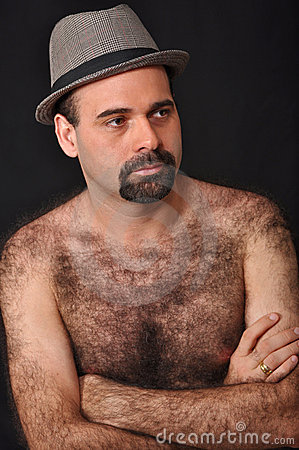
One: a hairy primate. (I like how the stock photo says “Dreamstime” at the bottom. Is he dreamy? I can’t tell.)

hairy-man-portrait-18128684

Two: a marble statue of a human figure in its ideal form, as imagined by the ancient Greeks.

images-2

Both represent humans. Still, how do we get from image one to image two? How do we recognize our animal status but continue to dream of perfection? Are they both true? Can they co-exist? Or do they cancel each other out?

Can Helen of Troy be the most beautiful woman in the world, worthy of a ten-year siege of Troy, but also be (woefully? wonderfully?) a hairy primate with an attractive vulva positioned for reproduction?

The magic of sex, it occurs to me, is that both images converge into one, for a brief spell! The abstracted beauty, the idea of perfection, but also the specific and sweaty truth of the matter. Both supplement the other.

But I digress.

The Troubled State of Humankind

A few days later, I am forgetting much. (I recall a very interesting contribution from Steve, for example, with Gerry adding to it, but can’t remember the content of that particular discussion.) I do remember, however, that at the end of the meeting we got around to an assessment of human angst generally. Why, members of the group asked, do we seem to be the most troubled, the most ambivalent, of animals?

If elephants and killer whales (to name two species who, like us, have complicated social lives) show grace and love and loyalty, qualities we aspire to in our own primate relationships, then can we learn from them?

Will we ever learn to live more harmoniously with our fellow animals?

Someone pointed out that it is likely that the problem of self-loathing, of self-disgust, did not exist for homo sapiens for many thousands of years. We might have had bad days (surely we had bad hair days), but we didn’t feel ashamed at our own species.

It was with the agricultural revolution, about 10,000 years ago, that we got shunted into close proximity and saw ourselves in a new light. We began to dwell on our viscous side, our manipulative side, our deceit. All of these qualities were always with us (they are with many animals), but now they became, painfully, more obvious. Frequent interactions with other humans can bring you down.

For a while we created a myth of progress and transcendence, as a kind of compensation. Our religions promised relief from our animal nature. But as we enter the 21st century that has become a stale dream. We recognize that despite some accumulated advances in culture, in some areas of the world at least — no public executions, no general tolerance for wife-beating or rape — despite all this, we are still stuck with ourselves.

So we seek in animals, perhaps, a lost innocence. An enviable ignorance, even. We wish ourselves back to a time when we were isolated enough, busy enough, verbally limited enough, not to see our own staggering limitations. Now we look around, glance in the newspaper, and all we can see is the status-mongering, the violence, the resource-hoarding. And it hurts.

Why do we look to animals? What can we learn from them?

After our discussion I would say that I still don’t know. Except for minor changes in my perspective (more sympathy for Cozy, who sits next to me right now licking her paws and looking nervous), I don’t know how my awareness of animals’ inner lives, and my acceptance of my own animals status, changes me. Yet, as I said at the meeting, I have an intuition that this awareness is at the core of a new kind of post-supernatural human morality… Much thinking and discussing and living still to do.

You? Write in with a comment to explain more about how recognizing yourself as an animal has changed you, if at all.

Thanks for a great talk everybody. I’m looking forward to our January meeting. Part of me feels that we we should pursue this subject farther.

I also want to address at some point, squarely, the role of anti-religious, anti-supernatural advocacy… in our age of open bigotry. Can they be made distinct? Can you be against religion but not give encouragement to those who preach hate against Muslims or other religious people? Interesting times. Troubling times. But then, what do you expect from a bunch of primates?

Tom

Reading for the Ninth Meeting — ISLAMOPHOBIA

SATURDAY, DECEMBER 19, 2015

For our January 21, 2016 meeting we will read three books. Two by bitter antagonists, Sam Harris and Reza Aslan, and one by Ayaan Hirsi Ali.

Sam Harris is a well-known atheist author, who considers Islam a dangerous ideology (as he does Christianity and Judaism and other world religions). Reza Aslan is an author on religion and a popular defender of Islam against its critics.

Our group is more oriented towards our private search for non-supernatural meaning. We are trying to forge new connections and find a new language. This is what we might call a positive approach. I don’t want to get us into a negative, “anti-” mode. But I do feel that due to recent events and U.S. presidential campaigns, anti-Muslim bigotry has become ubiquitous. I think it is important to distinguish critiques of religion — understood as supernatural-based ideologies — from acts of bigotry and hate. Where is the balance of harm, in today’s climate? I feel it is an important moment to take this on.

Here are the books:

Islam and the Future of Tolerance, by Sam Harris and Maajid Nawas

No god but God, by Reza Aslan

Heretic, by Ayaan Hirsi Ali.

Please write in with any more suggestions.

Setenay suggested another book, and it looks very interesting and thoughtful. It is In the Name of Identity: Violence and the Need to Belong, by Amin Maalouf. Please click on the title for a link to the PDF.

Some Notes on Our Reading in Advance of the “Islamophobia” Meeting

TUESDAY, JANUARY 19, 2015

On such a potentially heated topic, I want to begin by emphasizing what we all have in common in this group.

I believe that everyone in the Old New Way will agree that:

  1. Human beings should not suffer unnecessarily

–no “honor” killings by family members

–no stoning of adulterers or “apostates” or blasphemers

–no executions of homosexuals

–girls and women should have equal access to education

–no spousal abuse through physical violence or confinement

–no bigotry or discrimination

  1. There should be freedom of inquiry and speech (with minimal exceptions for safety)

–human lives are more important than any sacred books or words

–the most useful ideas are developed and honed through dialogue and even, in many cases, opposition and contradiction

–no one has a monopoly on the truth

  1. Violence is only acceptable as a LAST resort, even in political struggles

— violent “jihad” against people for their beliefs or identities or mere citizenship is not okay

–“martyrdom” operations are not okay

— killing of innocents is not okay (whether by drone or suicide!)

  1. Cultural differences are, in almost every case, enriching and wonderful

–different music, foods, clothing make our world better

–different priorities and social understandings make it more interesting (and we learn from one another)

  1. Western colonialism and resource exploitation did (and continue to do) undeniable harm to people in the Mideast

–artificially drawn national boundaries create tensions politically

–racism was – and continues to be – prevalent in relationship between West and East

— capitalist exploitation (taking oil profits, etc.) goes on

— the creation of the state of Israel in 1948 drove many Palestinians from their homes; the settlements are a forcible taking of Palestinian land

— the U.S.-led Iraq War killed thousands upon thousands of civilians

I list these first because once we establish that we all agree on these emotionally-charged issues, I hope we can have a more harmonious and directed discussion.

The problem, as you all know, is that when people disagree about religion and politics and the like, even small disagreements about how to get there can trigger limbic brain in-group mentalities and ingrained threat responses very fast.

So let’s try our best to avoid that adrenaline-fueled reaction entirely by agreeing, at the outset, that we largely share the same positions (as mentioned above, i.e. against unnecessary suffering, for freedom of inquiry and expression, concern about Western power and hegemony, etc.).

Anyway, our disagreements probably come down to a disagreement about tactics or approaches more than substance.

Okay.

Having said that, let’s look at this phenomenon of “Islamophobia” a little more closely.

What are its different forms and definitions? (Spoiler: I think the term “Islamophobia” is very unhelpful, since it conflates a number of vastly different concerns.)


Six Different Forms of “Islamophobia”

1. Bigotry, i.e. visceral hatred towards people from the Mideast

This is the most basic of all – it has no ideology.

(A better term for it than “Islamophobia” might be “anti-Muslimism”?)

It is an expression of the limbic brain in full throttle.

For any given bigot (or anti-Muslimist), it might be based on…

— fear/unfamiliarity/disgust with sounds of different language (Arabic, Farsi, Turkish)

— fear/unfamiliarity/disgust with different habits (daily prayers, clothes, food…)

— racism towards people with different color of skin

— rejection of/disgust with Islamic architecture (and/or art)

–feelings of superiority (due to white skin, European history of power, different education, etc.)

2. A Religious Agenda

This one is based on a kind of in-group/out-group, supernatural assessment that Muslims are wrong in God’s eyes

It is expressed by Israeli settlers, Hindu separatists, European-Christian nationalists and many Evangelical Christian communities in the U.S. It does not always overlap with bigotry of the racial kind.

It can take the form of

— arguments that Muslims are aligned with Satan or the anti-Christ

–concerns that God promised Jerusalem as the Jew’s “eternal city”

–apocalyptic rumblings about the return of Jesus and the Rapture (and the Jewish people’s prophesized return to their homeland)

–sometimes it is even accompanied by a sincere urge to convert and win over

3. Threat Assessment

This is (presented as) a fear-based response to geopolitical events

It is strongest in right-wing parties in Europe and Russia and the U.S. (but it is also present in the Mideast itself, in terms of justifying “strong men” governements and leaders)

It claims to argue not against Arabs et al. as a ethnic/social/cultural group, nor in religious terms, but rather in terms of “objective” security concerns… (this one, by the way, is Donald Trump’s stated position – as he says, “…until we figure out what is going on…”)

Often it includes

–arguments that ‘radical Islamists’ are infiltrating society through refugee status, immigration, etc.

–arguments about military strategy (e.g. “red lines,” the need for a show of force in the Mideast, checkpoints, etc.)

–even arguments for gun rights (see Marco Rubio’s Christmas eve purchase of a gun to protect his family “against ISIS”!)

4. Concerns about Religion Generally

The focus here is on the supposedly deleterious effects of supernatural thinking and organized religion, Islam being a case in point.

These may include:

–concern about perfectionism (as opposed to incrementalism, appreciation of hard choices, trade-offs, the need for compromise and understanding…)

–concern about the enshrinement of outdated cultural norms in a ‘sacred’ book

–concern about the fostering of in-group/out-group mentality

–concern about the culture of lies encouraged by supernaturalism (not looking to evidence, not developing critical thinking, habits of verification and falsification)

–concern about the ingrained habit of certainty (instead of the celebration of doubt)

–concern about abusive child rearing/indoctrination/control

–concern about sexual shaming/control

–concern about emphasis on afterlife at cost of this life

Note that when you view religion as merely a form of ideology, and not worthy of protection by taboo, then there are distinctions to be made between religions (just as their between ideologies). In terms of advocacy for peaceful coexistence and tolerance, for example, Islam does not come out on top. (Probably Jainism does? Or forms of native American shamanism?)

Then again, Islam is better on social equality between men-who-are-unequivocally-part-of-its-faith-tradition. So there’s that.

5. Concerns about Assimilation

This is sometimes merely a weak-tea version of bigotry and terrorism/security threat assessment… but it does have another, more substantive aspect as well, I believe.

This is the “high-minded” argument rolled out by the National Front in France or conservative commentators in the U.S…. when they want to sound as reasonable as they can.

It comes into play when their concerns are based on the sense that there is (or should be) a unified cultural community among citizens.

With this in mind, they express

–concern that Muslims “cocoon” themselves off in homogenous communities

–concern that values of free speech and pluralism may be anathema to the religion of Islam (or Mideastern culture?).

–concern that Muslim populations therefore, unintentionally or not, degrade the healthy civic life in the host country.

In theory, though not in practice, this concern would apply with equal force to any minority community that did not assimilate, such as Afrikaners in South Africa?

6. Concerns about Immigration Generally

This is similar to Concerns about Assimilation, above, but with a slight difference of emphasis: the argument is often more about jobs and crime.

This form of “Islamophobia” expresses

–concern that foreigners are taking native-born peoples’ jobs (Muslims from the Mideast being one such potential immigrant group)

–concern that new immigrants will undermine wages by agreeing to less pay, or organize themselves into collective groups that keep out native-born workers

–concern about welfare dependency of new, poor immigrants (and higher taxes to support such dependency)

–concern about increases in crime, drug use, sexual assault, etc. (see recent events in Cologne, Germany, and the strong reaction of the average German)


So these are some of the different concerns grouped under the label “Islamophobia.”

Considering that this is a non-supernatural group, I think perhaps we should now turn to looking in more detail at #4 (Concerns about Religion Generally), in the context of Islam.

That, I am guessing, is where most of us find ourselves (though some of us may also be drawn, perhaps against our better judgment, particularly after a terrorist event, to #3 and #5?).

The question I posed for this meeting was: Is it possible to criticize the religion of Islam without being a bigot, i.e. without denigrating the social/cultural aspects of Muslim life?

Or is it a fool’s errand to try to separate these different strands of Muslim identity, and you will always slide into hurtful bigotry if you try?


Criticisms of Islam

 We read three books. Here is a brief summary of the relevant arguments of each.


Ayaan Hirsi Ali, Heretic

Hirsi Ali divides the Muslim community into three “sets”:

  1. Mecca Muslims

This is the name that she gives to those Muslims – the majority world-wide – who are inspired by the more inclusive and spiritual-minded Koranic verses from Muhammed’s early years in Mecca. Many of these verses in the Koran emphasize equality and fairness and self-discipline and moral rectitude (along with submission to Allah).

  1. Medina Muslims

After Muhammed was driven from Mecca to Medina, his faith became more of a persecuted faith and a war-hardened faith. There are therefore many verses in the Koran that emphasize persecution, group solidarity, enforce rules and punish offenders.

  1. Modifying Muslims

This is the name Hirsi Ali gives to those Muslims and former Muslims, like herself, who are actively attempting to reform Islam. (She includes an Appendix in which she names many others whom she admires.)

Hirsi Ali addresses the question of why there has been no Islamic reformation – i.e. why the Modifying Muslims have made so little headway.

First, she says, Islam is not hierarchical, so change is dispersed and slow to catch on.

Second, there are fierce strictures against any and all critiques of Islamic religious doctrine.

Yet she still believes it can happen.

Hirsi Ali suggests five specific amendments to Islam that would initiate the reform she seeks.

  1. Reject Muhammed’s infallible status and literal readings of the Koran (this rejection of literalism has largely been achieved in the other Abrahamic monotheistic religions but has been resisted in Islam).
  2. Emphasize human lives as lived, over dreams of the after-life.
  3. Reject the authority of sharia law.
  4. Call into question the practice of empowering individuals to enforce Islamic law themselves.
  5. Abandon the concept of “jihad,” or holy war, entirely.

There are, of course, many challenges to reform:

All Muslims form a single community of believers (“ummah”), which makes them have a strong in-group/out-group mentality across the globe.

Traditional Arab culture is driven by a shame dynamic (instead of a guilt dynamic) – so one individual’s criticism, even if valid, is easily seen as an attack on the collective as a whole.

The Koran is sacrosanct. Unlike the Torah or the Bible, it is not a narrative but a series of commands, embedded socially through their recitation.

The Koran emphasizes divine omnipotence over human free will.

In many places, the text justifies violence. (Muhammed himself led his followers to victory numerous times on the battlefield.)

The concepts of martyrdom and the after-life are deeply embedded in it.

Sharia is understood by Muslims as a moral order (not merely a legal one).

The Koran empowers each Muslim to “command right and forbid wrong” himself or herself – i.e. it elevates all Muslims to the position of religious enforcers.

There has been an erosion of the idea of a zone of privacy in Muslim culture.

Jihad is in the Koran as a “spiritual struggle,” but also an outward one. One cannot deny the second imperative.

Global jihad is attractive to many disaffected youth as an easy “one size fits all” solution.

But Hirsi Ali cites these hopeful developments:

New information technology is exposing many to ideas outside their close communities.

The Arab spring, though brief, indicated growing unrest among many.


Reza Aslan, no god but God

Like Hirsi Ali, Aslan believes that there is a Muslim reformation underway. But unlike Hirsi Ali, Aslan does not see the Koran or the Islamic faith as presenting a unique challenge to reform.

On the contrary, he sees Islam as ripe with the possibility for reform and revision.

He insists that a religion is not a faith; it is the “story of a faith.” (This seems to suggest to him that it need not be factually true, so much as inspiring.)

So, with this in mind, Aslan sets out to tell us the story of Islam.

It begins with the story of a charismatic, handsome 25 year old, Muhammed, who impresses and marries a wealthy widow 15 years older than him. He then has a revelation in a cave and hears the voice of God giving him verses that speak of a new monotheism. Muhammed begins to proselytize, as a “prophet.”

Eventually, he marries others too (one wife, Aisha, is only six when she comes into his home, but we are assured that he did not consummate the marriage until she was nine – well, that’s a relief!). His followers soon have to escape the authorities in Mecca, the powerful Quraysh. In the dead of night, one by one, they flee to Medina, a small agrarian village many miles away.

Aslan describes the many threats faced by Muhammed and his followers when they in Medina. He explains that the outward-looking and aggressive forms of “jihad” are in the Koran because they were crucial for Muhammed in establishing his community. He acknowledges that this term of jihad has “been manipulated” for use by radicals and militants, but insists that most Muslims do not understand it this way (p. 81). Aslan also argues that the verses that seem to suggest Muslims “slay the polytheists,” etc. must be understood in a very narrow context of Muhammed’s conflicts with the Quraysh and others (p. 84).

He also minimizes the relevance of Muhammed’s mass execution of hundreds of Jewish Arabs in Medina – explaining it away as a matter of treason, not genocide (p. 94). He points out that Christians and Jews were not routinely killed when conquered by Muslims, nor were they even forced to convert (as polytheists and pagans were). Instead, they were merely compelled to pay a special tax (jizyah) under an Islamic state. Oh, and they were not allowed to openly worship or proselytize their faiths in public.

Aslan (to my ear, chillingly) summarizes Muhammed’s actions in this episode in the following way: “Worried that the rejection of the Jews would somehow discredit his prophetic claims, Muhammed had no choice but to turn violently against them, separate his community from theirs” (p. 95; emphasis added).

The question of the succession of leaders after Muhammed’s death takes up another chapter. After a few Caliphs come and go, Aslan is happy to report that one, “Abu Bakr’s was a short but highly successful reign… His principle achievement as Caliph was his military campaigns against ‘false prophets’ and those tribes who had ceased paying the tithe tax…” In other words, “successful,” to Aslan, is apparently defined in terms of a wider conquest and the expansion of the Muslim caliphate…

I was surprised at how war-like and troubling the story of this faith turned out to be, even in Reza Aslan’s favorable telling. He admits to the severity and misogyny of the interpreters of the Koran, but he emphasizes how much it has been manipulated and distorted in the process. I am sure he is right. But that doesn’t give me much confidence that it will be reversed and corrected, despite Aslan’s assurance that this will happen in due course. For, as far as I could glean, he does not seem to give much evidence for this course correction.

Sure, Aslan names a few reformers through the centuries. And he writes at length about Sufism. But that is not a dominant form of Islam (in fact Sufism is not even considered Islamic!). Aslan also describes the emergence of Islamic fundamentalism across the Mideast, and the rise of the Muslim Brotherhood in Egypt in particular, as being largely a result of Western colonialism and exploitation. Here too I am inclined to agree. But neither does that explain how such extremism will be eradicated or reduced with time. Nor does that fully account for its emergence (there are many parts of the globe that have been subjected to colonialism and exploitation of resources but have not seen the emergence of an ideology of violent “martyrdom” and totalitarianism).

In the final passages of his book, Aslan concludes that the West is “merely a bystander” to an internal struggle in Islam, which has “finally begun its Fifteenth Century” (p. 248). He announces this with a kind of awe and optimism.

Aslan’s hopes seem to be pinned to the idea that Islamic tradition has long had an appreciation for pluralism: see, for example, the jizyah tax on Christians and Jews instead of forced conversion. He believes that within a clear “Islamic moral framework” a pluralistic state, even a democratic one, is possible. He concedes cheerfully, however, that “there may be some circumstances in which Islamic morality may force the rights of the community to prevail over the rights of the individual” (p. 264).

But this concession, made in passing, gives away the game, doesn’t it? Notice the abstraction behind the words: “Islamic morality may force the rights of the community…” But of course, a “morality” would not be able to “force” anybody to do anything; rather, it would be certain individuals who would maintain control over that “morality” and its terms, and enjoy the monopoly of authority in order to enforce them. And anyway, a “community” does not have rights; individuals do. That’s the point of rights: that the aggregate doesn’t get to assert special high-powered rights that trump one person’s!

Aslan ends by saying that the “cleansing” of Islam is inevitable (p. 266). This strikes me as an unfortunate term, “cleansing,” loaded with the kind of perfectionist thinking that I deplore (and I believe religion promotes). The term “inevitable” here also sticks uncomfortably in my ears in this context of violent upheaval. It suggests a strangely passive approach to present-day suffering.


Sam Harris and Maajid Nawaz, Islam and the Future of Tolerance

Nawaz runs an organization in London, Quilliam, dedicated to the cause of reforming Islam. Harris is a well-known atheist and writer. The book mostly reads as an interview by Harris of Nawaz, with occasional commentary thrown in by Harris when he feel compelled to push back. This structure was fine with me, because I was impressed throughout with Nawaz’ clarity of expression and thought.

Nawaz makes it clear that his organization, Quilliam, is focused on encouraging Muslims to embrace the universality of human, democratic and secular values (he uses the term “secular” here in the limited sense of keeping religion and politics separate – not at all to suggest a renunciation of religion). He believes that this one change – Muslims coming to accept the universality of these values – could and would run parallel to religion without necessarily disrupting it. In his view, this development would provide a protected zone of critical thinking and privacy – and so, in turn, hasten the reform of Islam. Nawaz does not look for a sudden transformation of Islam anytime soon; rather, it will be a gradual, grinding process.

When they first met, Harris urged Nawaz to be more “honest” and call out the radicalism inherent in the Koran. But Nawaz strongly rejects this formulation of the situation he faces. He explains that he doesn’t believe that any written text “says” any one thing – so to call out some radicalism, as Harris wants him to do, would be incorrect. What Nawaz wants, instead, is to join others in encouraging an interpretation of the Koran which allows for a separation of Islamic faith and a person’s political identity.

Unfortunately, both Harris and Nawaz begin by describing the Islamic faith community as a series of concentric circles… (I found this description to be problematic, as I will explain below.)

In the center circle, they both put ISIS and Al Qaeda and all the other radicals dedicated to violent jihad, spreading the faith by way of the sword.

The next circle out is the Islamists, who seek to spread Islam through political action.

The next circle out from that is the conservative Muslims, who may or may not support the Islamists or even the jihadis actions, but are more focused on issues of private faith and morality (e.g. the traditional role of women, etc.).

Finally, in the outer ring, there are the moderate Muslims who want to live their lives by modern values: the sales reps, lawyers, street-cleaners, engineers, mothers and fathers, etc. who are Muslims mainly by cultural tradition.

Within the Islamists, Nawaz goes on to distinguish three subcategories: political, revolutionary, and militant. The political ones want to achieve their goal through the ballot box, the revolutionary ones in one fell swoop, and the militants through global violent jihad (in their radicalism, these last ones drop into the inner concencentric circle).

As I said, I think this whole visual lay-out is a distortion. I do not think it is fair to place ISIS and Al Quaeda at the CENTER of this description of Islam. Can’t we place the conservatives at the center, with the moderates near them, and the jihadis and the political Islamists as bubbles at the edges? Wouldn’t that be more accurate? Why must the most radical take center stage?

In the next section, Nawaz and Harris talk about indoctrination. Nawaz says that there are four stages in recruitment: grievance, identity crisis, a charismatic recruiter, and ideological dogma.

Nawaz point out that religious dogma is a motivator, but not the only motivator. So we have to look at all of these factors. Harris pushes back and argues that the unique dogma of Islam is sometimes sufficient to motivate a person to become radicalized to do violence in its name.

Their next subject is the rise of a Western “regressive liberalism,” in which any criticism of Islamic radicalism is labeled “Islamophobia” and bigotry. They both agree that this does huge harm to efforts to reform Islam from within. Nawaz acknowledges that bigotry is a problem, but he insists that “our challenge is to expose and undermine the ‘fellow-travelers’ [regressive liberals] while at the same time opposing the bigots” (p. 54). This is the needle they are trying to thread. Harris laments that the “liberals don’t see that they have abandoned women, gays, freethinkers, public intellectuals and other powerless people in the Middle East to a cauldron of violence and indifference” (p. 55). Both Nawaz and Harris agree that there needs to be careful distinction made between real grievances (employment discrimination, violence against Muslims) and perceived grievances (offensive cartoons in Charlie Hebdo).

On the text of the Koran, Harris is more adamant than Nawaz that it contains prescriptions for violence and intolerance that can’t easily be avoided. Nawaz maintains that it is a matter of interpretation – just as in the Torah or the Bible there are severe passages which have been interpreted more favorably. Harris says yes, to a degree — but some text cannot be softened or ignored. There is no way, for example, to interpret the Koran as encouraging the eating of bacon, no matter how hard you try.

Nawaz suggests two ways of loosening the literal (“vacuous”) readings of the Koran that are currently prevalent. One would be to understand it as open to interpretation (this recalls the first of Hirsi Ali’s “five amendments”). The other is to shift from understanding the text as a legal injunction to more of a spiritual guide. Nawaz looks at the command to kill “apostates” (which appears in the hadith, or classical commentary on the Koran) and discusses how this might be reinterpreted to eliminate the threat of violence, by way of these methods.

Harris articulates the two central themes in Islam that he finds the most problematic. One is the frequent demonization of infidels,  and the other is the emphasis on paradise. Nawaz acknowledges that these are challenging aspects to Islam. But he insists that with enough pressure these themes too can be reworked.

They conclude in agreement that the reform of Islam is daunting, but it must be achieved through a clear-eyed commitment to secularism both in the West and in the Middle East.

Reading for the Tenth Meeting — AGING

SATURDAY, FEBRUARY 6, 2016

For our next meeting, on Wednesday, February 24, 2016, we will examine the experience and meaning of aging.

From a non-supernatural perspective, what is the significance of the inevitable deterioration of everybody’s bodies as we grow older?

Of course there are the wrinkles, the hair loss, the many aches and pains… But also there is the deep knowledge of people, the recognition of patterns in human behavior, the long commitments sometimes bringing with them great sentiment, even love.

What does it mean to be “old”?

Do our elders — our parents, our friends, the old codger in line in front of us — deserve respect simply for being old? If so, why? Does the accumulation of experience add up to wisdom? If so, what is the nature of this wisdom?

Old age is a neglected topic of conversation in our youth-obsessed American culture. We shy away from it, talk instead of yoga and healthy diets and keeping up with the latest music. But perhaps it is not just our contemporary superficial, throw-away culture that is the culprit, in this case. Perhaps the major, supernatural-based religions, with their emphasis on the “transcendence” of this life, contribute to the denigration and devaluing of the experience of actual aging in this life.

My gut tells me that the more we shed our supernatural habits of mind, the more we begin to look to our elders as mentors, even as “spiritual” guides. For when life is all you have, and they have more of it, then they certainly have something, don’t they? The native Americans knew this.

A beautiful story: A friend of mine who works with local Indians told me once that whenever an elder comes into a room, every single person in the room, no matter how high status, is instantly aware of the elder’s presence. When he or she speaks, even just a single sentence, his or her words are invariably followed by a long silence, denoting the full attention and careful reflection of the listeners, before the conversation picks up again. That moved me a lot when I heard it.

Let’s read two books:

The Spectator Bird, by Wallace Stegner

Old Age, by Helen M. Luke

And watch two films:

Nebraska, directed by Alexander Payne

45 Years, directed by Andrew Haigh.

Bonus film to watch on your own: Venus, directed by Roger Michell and starring Peter O’Toole. This is a quiet, extraordinary film, made in 2006 when O’Toole — who, you will recall, played the dashing Lawrence of Arabia when he was young — was 74.

As for the films, you can watch them on your own, or we will have two separate screening nights, for those who can make it, before the meeting.

Nebraska on Friday, February 12, 2016. 8 pm for an 8:30 start at our house.

45 Years, on Monday, February 22, 2016. NOTE: We will see this one at a theater, the Landmark Shattuck theater in downtown Berkeley. 7:20 is the screening, so let’s meet at 7:10 outside the theater. Here’s the link: http://www.landmarktheatres.com/san-francisco-east-bay/shattuck-cinemas

Happy reading.
Tom

More Reading for the Tenth Meeting — AGING

THURSDAY, FEBRUARY 18, 2016

Some of our members have sent in more suggestions for our upcoming meeting.

*

First, here’s a link to the story I sent out the other day: “Mother’s Day” by George Saunders.

*

Hulya sent in a link to an article with an, ahem, eye-catching title:

Firming the Floppy Penis: Age, Class and Gender Relations in the Lives of Old Men,” by Toni Calasanti and Neal King.

Click here (Firming The Floppy) to read.

*

Setenay sent in the following poem:

Weathering – Fleur Adcock

My face catches the wind
from the snow line
and flushes with a flush
that will never wholly settle.
Well, that was a metropolitan vanity,
wanting to look young forever, to pass.
I was never a pre-Raphaelite beauty
and only pretty enough to be seen
with a man who wanted to be seen
with a passable woman.

But now that I am in love
with a place that doesn’t care
how I look and if I am happy,
happy is how I look and that’s all.
My hair will grow grey in any case,
my nails chip and flake,
my waist thicken, and the years
work all their usual changes.

If my face is to be weather beaten as well,
it’s little enough lost
for a year among the lakes and vales
where simply to look out my window
at the high pass
makes me indifferent to mirrors
and to what my soul may wear
over its new complexion.

*

She also suggested an essay on aging by Grace Paley, “My Father Addresses Me on the Facts of Old Age.” Click here for the link.

*

I have a couple of others.

One is an nasty, but famous, poem by the contemporary poet Frederick Seidel. Despite its surface aggression about the “total nightmare” of an old woman’s body, I read it as being, more interestingly, about the total nightmare of an old man’s habits of mind, his self-hatred, his pinched and painful outlook, if he has refused to age. (It is never clear, when reading Frederick Seidel, how much distance —  if any — the poet has from the assholic poet-narrator of the poems, also called “Frederick Seidel.”)

Here is a youtube video of Seidel reading it aloud, if you can stand it:

The other poem I include here is by Philip Larkin:

The Old Fools

What do they think has happened, the old fools,
To make them like this? Do they somehow suppose
It's more grown-up when your mouth hangs open and drools,
And you keep on pissing yourself, and can't remember
Who called this morning? Or that, if they only chose,
They could alter things back to when they danced all night,
Or went to their wedding, or sloped arms some September?
Or do they fancy there's really been no change,
And they've always behaved as if they were crippled or tight,
Or sat through days of thin continuous dreaming
Watching the light move? If they don't (and they can't), it's strange;
			Why aren't they screaming?

At death you break up: the bits that were you
Start speeding away from each other for ever
With no one to see. It's only oblivion, true:
We had it before, but then it was going to end,
And was all the time merging with a unique endeavour
To bring to bloom the million-petalled flower
Of being here. Next time you can't pretend
There'll be anything else. And these are the first signs:
Not knowing how, not hearing who, the power
Of choosing gone. Their looks show that they're for it:
Ash hair, toad hands, prune face dried into lines -
			How can they ignore it?
	
Perhaps being old is having lighted rooms
Inside you head, and people in them, acting
People you know, yet can't quite name; each looms
Like a deep loss restored, from known doors turning,
Setting down a lamp, smiling from a stair, extracting
A known book from the shelves; or sometimes only
The rooms themselves, chairs and a fire burning,
The blown bush at the window, or the sun's
Faint friendliness on the wall some lonely
Rain-ceased midsummer evening. That is where they live:
Not here and now, but where all happened once.
			This is why they give

An air of baffled absence, trying to be there
Yet being here. For the rooms grow farther, leaving
Incompetent cold, the constant wear and tear
Of taken breath, and them crouching below
Extinction's alp, the old fools, never perceiving
How near it is. This must be what keeps them quiet:
The peak that stays in view wherever we go
For them is rising ground. Can they never tell
What is dragging them back, and how it will end? Not at night?
Not when the strangers come? Never, throughout
The whole hideous inverted childhood? Well,
			We shall find out.

*

I am looking for more explorations of a woman’s experience of aging. Please hit the books and send them in!

See you Monday (for the movie 45 YEARS at 7:20 pm at the Landmark Shattuck Theatre in Berkeley) or Wednesday for the meeting. Or both!

Notes on Our Tenth Meeting — AGING

SATURDAY, FEBRUARY 27, 2016

A lot of people showed up to discuss aging. Who would have guessed that this, of all topics, would draw such enthusiasm?

We enjoyed some bread and cheese, red and white wine, tea, a delicious bulgur salad brought by Setenay, and colorful cupcakes brought by Dean.

At 8:30 pm, we made our way to the living room.

1. Tom’s Presentation: A Norwegian Folk Tale and… a Musical Time Lapse

First the story. I read it most recently in Robert Bly’s book, The Sibling Society (in which he laments the increasingly youth-obsessed, horizontally-structured contemporary culture, and poses this story as a counterpoint).

Being part-Norwegian in my ancestry, I had actually stumbled upon it before with my son George, and it gave us a good laugh at the time.

It is an old Norwegian folk tale.

A traveller is lost in a snowy wood. He trudges along as the sky darkens. Just as he is almost giving up hope, he sees a small cabin ahead of him.

A man, who looks to be about 30 years old, chops wood outside of it.

“Excuse me,” says the traveller. “May I possibly stay the night with you? Night is falling, and I am far from home.”

“You must have been very worried,” says the man, leaning against a stump. “I am glad you found this house. But you will have to ask my father.” He points to the front door.

So the traveller climbs up the steps to the front door and enters.

Inside, he is met with warmth. A fire burns in the kitchen stove. He sees a man of about 60 years, crouching on the dirt floor to feed more kindling into the stove.

“Excuse me,” says the traveller. “May I stay the night with you? I am lost, you see.”

“I am glad you found this house,” says the man, “But you will have to ask my father.” He points to a room farther in.

The traveller goes in. The inner room is dark, but he can barely make out an armchair in the corner. An old man of about 80, quite shrunken, his skin so gray as to appear colorless, sits on it.

“Excuse me,” says the traveller. “May I stay the night here?”

“I understand why you asked,” says the old man. “But you will have to ask my father.” He waves a finger at the far corner of the room.

The traveller feels his way until he bumps into a small bed. On it lies a man of about 100 years, very small. The man peers up at the traveller with sunken eyes.

“May I stay the night?” asks the traveller. “I would think so,” whispers the old man, “But you will have to ask my father.”

In the corner of the room, the traveller sees a crib. Stepping closer, he sees little wrinkled man curled up inside of the crib. He bends down and says, in the gentlest voice possible, “May I spend the night in this house?”

This little old man, who looks to be no more than six inches long, answers, “You will have to ask my father.”

Following the gaze of the shrunken man below him, the traveller turns to looks up at the ceiling. He sees a hunting horn, hanging from a beam over his head. When he comes closer, he sees, sleeping on it, a very old man, about an inch long.

“May I stay the night with you in this house?” asks the traveller.

The old man looks up, the skin sagging from his face. “Yes,” he says.

The group, properly freaked out by now, let out a laugh… followed by a kind of groan. (Terror? Recognition? Hard to say.) But really, when you think about it, I said, we all have these little “fathers” and little “mothers” inside of us, our ancestors, all the time.

With that, I moved on to the next part of my presentation.

I am going to play you a familiar song, I said.

First, we will hear this song performed by the artist when he was a very young man.

Next we will hear it played after a lifetime of experiences. Same song, same words, same music. Completely different meaning.

I pushed play and Bob Dylan began singing, “The Times They Are a Changin” from his 1964 album by the same name.

After about a minute I faded the volume down. Then I played Dylan singing the same song, many years later (I played the version from his MTV Unplugged concert in 1995.)

Here is a video of him playing it at the White House as recently as 2013, almost 50 years after he released it:

Listen to how the whole perspective has shifted…

Same person.

Entirely different person.

2. The Question of “Wisdom”

Lucie started us off on the right note by observing that aging is a gift. Any complaints we have are completely overshadowed by the blessing of being able to live into old age. That was a good thing to have in mind as we started getting into it.

Ken and Kristen, in quick succession, suggested that, in their experience, older people accumulate a kind of “wisdom” from which we can learn.

Kristen spoke lovingly of her grandfather, who had an intelligent and inquisitive mind and, as a result, consistentuly gave wonderful advice to her.

She recalled how, for example, in the days following 9-11, feeling completely distraught, she called her grandparents for perspective. Having lived through World War II and Hiroshima and, well, the latter half of the 20th century, her grandfather explained that he saw this event as part of the movement of history. His experience told him that people across the world would surprise her and rise to the challenges posed by terrorism; that terrible events sometimes herald a powerful response.

Ken, too, spoke of the wisdom of elders, and how we should venerate them for their varied experiences.

I explained that my starting-point for the discussion was quite different.

You see, I said, having seen Nebraska, I had developed a new understanding of what this so-called “wisdom” of age represents… The old man played by Bruce Dern in Nebraska is — let’s be clear about it — a total dick. He is selfish, obstinate, repressed, grouchy to an extreme degree, an alcoholic, quite possibly demented. We begin the movie convinced that he is nothing but a problem, certainly an almost unbearable burden on his son (who appears to be in his 4os).

Yet at the movie progresses we come to appreciate that the common notion of an inheritance, a “legacy” if you will, moving from the older generation to the younger generation, is really quite superficial, even specious. It’s true, this old man has very little to give: no insight, no kindness, certainly not any money. But the gift of a “legacy,” we come to realize, is really one that the younger generation bestows on the older one. Over the course of the movie the 40-something son first recognizes, and then chooses to honor, his father’s fully subjective, singular understanding of the world, even with all of its foibles.

Perhaps the “wisdom” of old people, then, is not an objective accumulation of knowledge or insight — they still may get it all wrong and even, on many occasions, act like total dicks. Instead, though, I learned from this film that “wisdom” is the accumulation of subjectivity. It is a kind of nutrient-rich water. An old person deserves respect by his or her very singularity.

I mentioned that seeing this movie actually changed my relationship with my own parents. I sat there on the couch, after watching it, and thought about how, as I enter this chapter of life, I am faced with a choice: complain about my parents, as so many do, or accept them as they are. I choose to honor their subjective understandings of the world (without necessarily agreeing with them). I choose to cherish, rather than judge. To me, their “wisdom” is real because it is more deeply theirs, not because they know more than anyone else.

Claudine pointed out that we can appreciate our parents — and older people generally — for the knowledge or insight that they may have, while at the same time acknowledging that they have other blind-spots and failings, as do we all. In her case, she recognizes her father’s vast array of factual knowledge and analytical skill, and she turns to him for answers when these apply. He may have very different values than she does (as she experienced on a recent vacation in her parents’ retirement community), so there are other areas that she may not turn to him for advice — for example, parenting questions about the use of digital technologies? And that’s alright.

Walden spoke up to play “devil’s advocate,” as he put it. He pointed out that many of the obstacles in the way of a more just and equitable society are put up by old people. He had two words for us: Trump voters.

So why should we defer to and venerate older people? Maybe wisdom resides in youth?

I answered that while it is true that many old people get much wrong, stuck as they are in traditional habits of mind, etc., still, they seem to have an intangible sense of things that younger people don’t. It’s not their grasp of facts, or any one experience they have tucked under their belts… It’s some kind of wily “getting-it” that seems to accrue to them over time.

I posited that even the most ill-informed, gray-haired, foul-breathed, flag-waving Trump supporter, after a day spent blabbing on about illegal immigrants and Muslim terrorists, might have… some strange, subjective insight about a relationship problem you faced, if you sat together for breakfast. The wisdom of older people may be something like a spice cabinet. You open one jar and it is empty. You open another, and you can’t believe how much you have missed that particular flavor all your life.

Walden acknowledged that it is true that older people can have surprising insights; he didn’t disagree with what I said. But his point still held, that they are sometimes apotheosized too much, considering their limitations.

3. Cultural Differences

Setenay talked about how in Turkish and Circassian cultures old people are treated very differently.

When an older person enters a room (whether that person is an uncle or a great aunt or merely a friend of your father’s), anyone younger rises. You converse with older people with a different language altogether, than you do your friends. (I imagine that even eye contact is sustained longer?)

When Setenay first moved to the United States she was horrified that her friends would even think to label their parents with run-of-the-mill adjectives: they are “really old-fashioned,” she’s so “uptight,” oh my god they were acting so “ridiculous,” my dad’s “going through a midlife crisis,” when my mom called she started getting so “picky,” and so on. She would not think of summing up the characters or behavior of her parents in this way: to a Turkish girl her parents simply are who they are, and she is not to try to pin them to a board like a collector of butterfly species.

Anne, from Germany, mentioned that Germans, too, have a sense of obligation and duty to their elders. But she said that cultural differences do not override reality. She emphasized that older people, however we may want to ignore it, do show a variety of personal traits, regardless of the cultural protections that they may be afforded.

Some may be generous and thoughtful and deserving of lifelong respect. Some — sorry, but it is undeniable — may be undeserving of much at all! They may be physically abusive, deceitful, hateful, jealous, divisive, small-minded. And in such cases, whatever the cultural construct, younger people may need to call their elders out. (I think of two amazing movies that show cases of this: Monsoon Wedding and Celebration — if you haven’t seen either of these you should, immediately — they are unforgettable.)

Yann spoke of his relationships with his French mother and Austrian father. When he was quite young he came to accept the ways in which he would have to care for them, rather than be cared for by them. Yet this did not engender bitterness or ingratitude in his case.

“Why is that?” I asked. He answered, simply, that in his early 20s he recognized that his parents were who they were — and were not capable of changing. So he came to love and accept them even with their limitations. His mother (a very impressive woman — I have come to know her) is blind, and this means that Yann has to worry for her on many occasions, but this is not a burden. He simply accepts it as part of the fabric of their life.

Some members in the group  wondered, though, at how much this kind of respectful treatment of elders is made possible by having ample resources. Even Yann agreed that there may be an economic calculus at work, and as older people become less… economically valuable, they become, correspondingly, more expendable.

Anshu mentioned that in India more and more old people are all but abandoned by their children — to run-down group homes or even worse. They are simply too expensive to maintain.

Marie-José said that sometimes a person just needs the right combination of factors to sweeten the end of life. Her French father, who was often an unpleasant person when she was growing up, in recent years has made a complete turnaround. Two changes took place: first, he developed a healthy fear of death (an aneurism did that) and, second, his doctor upped his bipolar medication. The combination has made him a happy, charming man, a man whom she had rarely before seen.

We all agreed that it is so intensely individual, this aging process. Each parent, each person, accumulates physical ailments, emotional states, psychological conditions, moments of grace and ongoing torments — and the end-result is completely unpredictable.

Looking around the room, we might ask: who among us will age well in the next 30 years? Who might age poorly? We have no idea.

4. How to Age Gracefully

With one exception: Don.

I revealed to the room that Don is in his 70s. (Okay, just 70 years old… but still, impressive!) Everybody went into shock, as we all know Don to be one of the most vigorous, open-minded, bright-eyed, youthful people we know. His cheeks glow, his blue eyes flash. He is interested in… um… pretty much everything. He has many friends in their 20s, 30s, 40s. He teaches multiple classes, attends film festivals, concerts, writer’s evenings. In short, what gives, Don? How do you do it?

He said that he takes satisfaction in thinking of his life as a series of rooms. Each time he leaves a room, the doors close behind him. But he leaves it without regret. That is because he fully inhabits each room as he goes, and then is fully done with it.

At the same time, he finds that the friendships and relationships he has nurtured in these rooms do not go away! You might say that we walk with him into the next room, and the next.

So he seems to have a way of being present but not attached to the setting or the habits of each phase. Right now, for example, he is an active grandfather. What will this room hold for him? What will the next hold when the kids go off to preschool?

5. Gender Differences

Hulya spoke up to say that she wanted to hear more about the experiences of the men in the room, as we find ourselves aging. What do we fear? What are we struggling with?

Since she was the one who had sent in an article entitled “The Floppy Penis,” the men in the room knew exactly what she was getting at. But we ignored that insinuation altogether. (We will leave her to her own speculations in that regard; perhaps they will better retain their… um… form that way?)

Instead, I answered exclusively in regards to men’s mental lives.  I mentioned that I have noticed my parent’s generation of men seeming to become more narrow and closed-off than the women their age, and this worries me greatly. For already, at 46, I feel the appeal of becoming more… narrow. It calls to me like a spell, like a song coming from deep in a forest…

Just do what you like, Tom.

Stop trying to please other people.

Just do what you know. What works.

There’s something appealing in this for men. (Am I right, guys?)

I can imagine myself at, say, 70, living a far more simple life, reading my books, planting a garden somewhere (if I’m lucky), driving my car around town for some errands, not giving a hoot about the larger world of demands and expectations.

This, I think, is a trap that men can fall into. They close off, narrow down, and it feels liberating, until it tips into obstinacy and isolation.

In my experience, older women, on the other hand, seem to grow ever more wide-ranging and open in their interests and affections. They sparkle and smile, and squeeze hands in secret communication. They make an effort to travel and increase their exposure to the frictions of life, all at the very same time that their husbands or other men they know seek to insulate themselves.

It seems to be a cause for much friction in old people’s relationships. We saw it represented in Stegner’s The Spectator Bird.

I explained that I want to resist this, yet I want to take the best of it too. I like the idea of honing down to the core, the movement to simplicity; I just don’t want to be an old codger.

So how do we men recognize when we are at the tipping point? When we start to “calcify”? (Don’s word — or did you say, “ossify”?) It’s a good question for men.

But there is another dilemma facing older men, I added: the question of sex. (I guess I couldn’t help myself and stumbled into the physical aspects of aging for men, after all.) It seems to me that men face a kind of binary choice in their old age. Either they… turn away, succumb, relinquish their youthful urges, soften into their old age (Hulya’s ears just pricked up at the word “soften”). Or they refuse to “go gently into that good night”! Is there a middle ground?

The poem I included by Frederick Seidel is one of many he writes in which he brazenly boasts of his triumph over Time… as a conqueror of young women. His poems are full of images of his old, gray, flabby body matched up against soft-skinned women with rosy lips and luscious hair… and more. Many older men (at least those with a modicum of financial success and status) face this choice in a way older women do not:

Do you go for it? 

Or do you refuse (so as to honor other values, like loyalty, tenderness, mutuality…)?

What does it mean to “age well,” from a man’s perspective?

Indeed, you see many men in the Bay Area leave their long-term marriages, even at the cost of their devotion to their children and their network of hard-earned friendships. In effect, going for it. Are they wrong to do this?

And it’s not just Seidel. A more decorous poet like Robert Hass writes of this dilemma too (indeed, he went for it, and left his marriage for a younger woman):

Against Botticelli

1.

In the life we lead together every paradise is lost.

Nothing could be easier: summer gathers new leaves

to casual darkness. So few things we need to know.

And the old wisdoms shudder in us and grow slack.

Like renunciation. Like the melancholy beauty

of giving it all up. Like walking steadfast

in the rhythms, winter light and summer dark.

And the time for cutting furrows and the dance.

Mad seed. Death waits it out. It waits us out,

the sleek incandescent saints, earthly and prayerful.

In our modesty. In our shamefast and steady attention

to the ceremony, its preparation, the formal hovering

of pleasure which falls like the rain we pray not to get

and are glad for and drown in. Or spray of that sea,

irised: otters in the tide lash, in the kelp-drench,

mammal warmth and the inhuman element. Ah, that is the secret.

That she is an otter, that Botticelli saw her so.

That we are not otters and are not in the painting

by Botticelli. We are not even in the painting by Bosch

where the people are standing around looking at the frame

of the Botticelli painting and when Love arrives, they throw up.

Or the Goya painting of the sad ones, angular and shriven,

who watch the Bosch and feel very compassionate

but hurt each other often and inefficiently. We are not in any painting.

If we do it at all, we will be like the old Russians.

We’ll walk down through scrub oak to the sea

and where the seals lie preening on the beach

we will look at each other steadily

and butcher them and skin them.

2.

The myth they chose was the constant lover.

The theme was richness over time.

It is a difficult story and the wise never choose it

because it requires a long performance

and because there is nothing, by definition, between the acts.

It is different in kind from a man and the pale woman

he fucks in the ass underneath the stars

because it is summer and they are full of longing

and sick of birth. They burn coolly

like phosphorus, and the thing need be done

only once. Like the sacking of Troy

it survives in imagination,

in the longing brought perfectly to closing,

the woman’s white hands opening, opening,

and the man churning inside her, thrashing there.

And the light travels as if all the stars they were under

exploded centuries ago and they are resting now, glowing.

The woman thinks what she is feeling is like the dark

and utterly complete. The man is past sadness,

though his eyes are wet. He is learning about gratitude,

how final it is, as if the grace in Botticelli’s Primavera,

the one with the sad eyes who represents pleasure,

had a canvas to herself, entirely to herself.

This conversation topic, admittedly a distasteful one, dropped like a stone.

(Isn’t there something about an older male poet boasting of his sexual performance — especially when he compares it to stars first exploding and then “resting now, glowing” — that is particularly irritating? Or do you think I am being unfair? Is this ageism at work? Please comment.)

6. Concluding Thoughts

Much more was said, but it is beginning to blur for me, a few days out.

There were some hilarious physical gestures made by M-J, which I will not describe, some touching stories by many members of their own experiences.

At one point Dean emphasized that he has turned to living a more “juvenile” lifestyle in this latest chapter of his life. “I have absolutely nothing going on in my head,” he declared, “The lights are completely turned off.”

We all laughed, knowing full well that this is not the case (if only based on his insightful contributions to our discussions at these meetings!)

I ended by saying that I am so often aware, during these discussions, that we are merely scratching the surface of these topics. When we talk for a few hours about what it means to be animals, or how we may better understand aging, we clarify our thinking in useful ways. But after this initial clarification, like a quick soap and a rinse, we need a long soak.

I hope that we can return to these topics again, circle back, and that our discussions may, over time, become less about clarifications, less about point-counterpoint. I wonder if we can structure the meetings so that they offer opportunities for an experience almost like a meditation? What is aging to you, once we get beyond the sharing of ideas and observations? What is it in your most quiet moments?

Next time we address this topic, some suggested, perhaps we can go around the room, and everyone can take a moment to talk about how he or she would like to age? What is the vision you have for yourself in 20, 30 years? Describe the setting you imagine, the details of your life, the (hopefully varying!) routines, the persistent thoughts you hope to have…

Thanks for participating, everybody. See you next month.

Tom

Reading for Our Eleventh Meeting — PHOTOGRAPHY

SUNDAY, MARCH 6, 2016

Screen Shot of Cable News
 An image (taken with my cell phone) of our home TV on pause on Friday, March 4, 2016.

Our topic this month will be PHOTOGRAPHY.

Can art function as a “religion,” as some people claim?

Can a painting, a song, a sculpture, a performance, even a photograph, give us meaning?

What do representations of the natural world do for our particular species of primate, homo sapians?

Why do we seek them so avidly? Why do they fill us with longing? Make us shiver? Sometimes even change us forever?

17287
“Fence” by Gerhard Richter (2008)

Three readings:

1. Roger Scruton, BEAUTY: A VERY SHORT INTRODUCTION
2. Susan Sontag, ON PHOTOGRAPHY
3. Erroll Morris (the documentary filmmaker), BELIEVING IS SEEING

I have a hunch that the best approach will be a more narrow one. So I would like to read this month on photography — which is, after all, the most prevalent contemporary form of representation.

I think that, through that lens (!), we might get somewhere. As always, let’s make it personal. What is the meaning of image-making, photographs, video, film to you?

See you at the meeting.

Tom

***

Note:

I propose that we pursue the question of BEAUTY more broadly, at a future meeting. With that in mind, would you help me to start gathering possible books to read?

Here are few I have collected so far to get our list started…

HISTORY OF BEAUTY by Umberto Eco

THE ART INSTINCT: BEAUTY, PLEASURE AND HUMAN EVOLUTION by Denis Dutton

BUT IS IT ART? by Cynthia Freeland

THE GOOD, THE TRUE, AND THE BEAUTIFUL: A NEURONAL APPROACH by Jean-Pierre Changeux

STRANGE TOOLS: ART AND HUMAN NATURE by (our own friend and neighbor, who perhaps will join us?) Alva Noë

A BEAUTIFUL QUESTION: FINDING NATURE’S DEEP DESIGN by Frank Wilczek

(Again, these are not for our March meeting, but for later. I’ll keep adding your suggestions as they come in.)

*

Kristen wrote with some additional titles! Here is what she added:

When I think of the Sontag piece, a couple supplementary resources come to mind:

1. Benjamin, Walter: The Work of Art in the Age of Mechanical Reproduction (short essay)

2. Salgado, Sebastião: The Salt of the Earth (documentary film)

3 .JR: TED talk (clichéd source, I know) by an artist who crosses lots of boundaries in how he defines himself as an artist, how he understand subject matter, & how he defines authorship.

I don’t yet know the Scruton piece. Anything with Beauty in its title always brings me back to Keats. I’m curious to read this new piece.

*

Walden wrote with some provocative thoughts too. And a suggested reading: Niklas Luhmann, Art as a Social System.

Here are Walden’s questions going in…

Dear Tom,

I have been trying to figure out your choice of a narrow focus on
photography, since of all of the art forms, it is probably the one
least associated with a “religious” experience — at least in
comparison to music, literature, architecture, film, and even some
painting. I am sure someone will try to point to a photograph that
contradicts this, but I will still be skeptical. A good question is
why this might be the case? Is even some painting “dynamic” in a way
that most photographs cannot be?
I say this as a consumer, since I am not an artist, but I cannot think
of an example of a photograph that has ever taken me to the same
levels of aesthetic impact as the other art forms I mentioned.

Best wishes,

Walden

A week later he wrote with another interesting find:

This landscape photographer’s statement suggests that the MAKING of
his photographs is a religious experience. This is different from the
viewer’s experience of the photograph, which I would admire but not be
transported significantly by, the way I would be by being directly in
nature.

Rex Naden Photography
http://www.rexnaden.com/misc/pages/About.html

*

Marie-José wrote in to suggest John Berger’s WAYS OF SEEING.

Here is the first of four short (20 minute) videos available on Youtube:

Some More Readings for Our Eleventh Meeting — PHOTOGRAPHY

MONDAY, MARCH 28, 2016

Hi Old New Wayers,

For the meeting on Wednesday night, I would like everybody (who can make it) to bring at least one photo or image with you.

(Yes, it can be on a screen, so long as we can pass it around!)

Bring something that either:

  1. Strikes you as beautiful or artistic in some way, or
  2. Represents something important or meaningful to you (that is, even if it is not “beautiful or artistic”).

I would love to talk about the role of photos and images in our lives (including Instagram, Facebook, family photos, etc.).

Do they bring us meaning? How do they interfere with it?

Why are we compelled to represent the rush of our lives in a static form? How does it interact with our natural ways of remembering? What do you like to look at in photographs, and why?

Lots of interesting questions that we all ponder sometimes. It will be useful, I think, to examine them together.

*

Also, if you scroll down to the bottom of our Reading for Our Eleventh Meeting on March 30, 2016 — PHOTOGRAPHY  post, and you will find two videos worth watching. One is a TED talk by JR (suggested by Kristen), the other is a link to John Berger, Ways of Seeing (suggested by Marie-José).

*

An artist friend, Jessie Thatcher, submitted the following essay by Agnes Martin:

Beauty Is the Mystery of Life
by Agnes Martin
When I think of art, I think of beauty. Beauty is the mystery of
life. It is not in the eye, it is in my mind. In our minds there
is awareness of perfection.
We respond to beauty with emotion. Beauty speaks a message to
us. We are confused about this message because of distractions.
Sometimes we even think that it is in the mail. The message is
about different kinds of happiness and joy. Joy is most
successfully represented in Beethoven's Ninth Symphony and by
the Parthenon.
All artwork is about beauty; all positive work represents it and
celebrates it. All negative art protests the lack of beauty in
our lives. When a beautiful rose dies, beauty does not die
because it is not really in the rose. Beauty is an awareness in
the mind. It is a mental and emotional response that we make. We
respond to life as though it were perfect. When we go into a
forest we do not see the fallen rotting trees. We are inspired
by a multitude of uprising trees. We even hear a silence when it
is not really silent. When we see a newborn baby we say it is
beautiful – perfect.
The goal of life is happiness and to respond to life as though
it were perfect is the way to happiness. It is also the way to
positive artwork.
It is not in the role of an artist to worry about life – to feel
responsible for creating a better world. This is a very serious
distraction. All your conditioning has been directed toward
intellectual living. This is useless in artwork. All human
knowledge is useless in artwork. Concepts, relationships,
categories, classifications, deductions are distractions of mind
that we wish to hold free for inspiration.
There are two parts of the mind. The outer mind that records
facts and the inner mind that says "yes" and "no." When you
think of something that you should do, the inner mind says "yes"
and you feel elated. We call this inspiration.
For an artist this is the only way. There is no help anywhere.
He must listen to his own mind.
The way of the artist is an entirely different way. It is a way
of surrender. He must surrender to his own mind.
When you look in your mind you find it covered with a lot of
rubbishy thoughts. You have to penetrate these and hear what
your mind is telling you to do. Such work is original work. All
other work made from ideas is not inspired and is not artwork.
Artwork is responded to with happy emotions. Work about ideas is
responded to with other ideas. There is so much written about
art that it is mistaken for an intellectual pursuit.
It is quite commonly thought that the intellect is responsible
for everything that is made and done. It is commonly thought
that everything that is can be put into words. But there is a
wide range of emotional response that we make that cannot be put
into words. We are so used to making these emotional responses
that we are not consciously aware of them until they are
represented in artwork.
Out emotional life is really dominant over our intellectual
life, but we do not realize it.
You must discover the artwork that you like, and realize the
response that you make to it. You must especially know the
response that you make to your own work. It is in this way that
you discover your direction and the truth about yourself. If you
do not discover your response to your own work, you miss the
reward. You must look at the work and know how it makes you
feel.
If you are not an artist, you can make discoveries about
yourself by knowing your response to work that you like.
Ask yourself, What kind of happiness do I feel with this music
or this picture?
There is happiness that we feel without any material
stimulation. We may wake up in the morning feeling happy for no
reason. Abstract or nonobjective feelings are a very important
part of our lives. Personal emotions and sentimentality are
anti-art.
We make artwork as something that we have to do, not knowing how
it will work out. When it is finished we have to see if it is
effective. Even if we obey inspiration we cannot expect all the
work to be successful. An artist is a person who can recognize
failure.
If you were a composer you would not expect everything you
played to be a composition. It iss the same in the graphic arts.
There are many failures.
Artwork is the only work in the world that is unmaterialistic.
All other work contributes to human welfare and comfort. You can
see from this that human welfare and comfort are not the
interests of the artist. He is irresponsible because his life
goes in a different direction. His mind will be involved with
beauty and happiness. It is possible to work at something other
than art and maintain this state of mind and be moving ahead as
an artist. The unmaterial interest is essential.
The newest trend and the art scene are unnecessary distractions
for a serious artist. He will much more rewarded responding to
art of all times and places – not as art history but considering
each piece and its value to him.
You can't think, My life is more important than the work, and
get the work. You have to think the work is paramount in your
life. An artist's life is adventurous: one new thing after
another.
I have been talking directly to artists, but it applies to all.
Take advantage of the awareness of perfection in your mind. See
perfection in everything around you. See if you can discover
your true feelings when listening to music. Make happiness your
goal. The way to discover the truth about this life is to
discover yourself. Say to yourself, What do I like and what do I
want? Find out exactly what you want in life. Ask your mind for
inspiration about everything.
Beauty illustrates happiness: the wind in the grass, the
glistening waves following each other, the flight of birds – all
speak of happiness.
The clear blue sky illustrates a different kind of happiness,
and the soft dark night a different kind. There are an infinite
number of different kinds of happiness.
The response is the same for the observer as it is for the
artist. The response to art is the real art field.
Composition is an absolute mystery. It is dictated by the mind.
The artist searchers for certain sounds or lines that are
acceptable to the mind and finally an arrangement of them that
is acceptable. The acceptable compositions arouse certain
feelings of appreciation in the observer. Some compositions
appeal to some, and some to others.
But if they are not accepted by the artist's mind, they will not
appeal to anyone. Composition and acceptance by mind are
essential to artwork. Commercial art is consciously made to
appeal to the senses, which is different. Artwork is very
valuable and it is also very scarce. It takes a great deal of
application to make a composition that is totally acceptable.
Beethoven's symphonies, with every note composed, represent a
titanic human effort.
To progress in life you must give up the things that you do not
like. Give up doing the things that you do not like to do. You
must find the things that you do like – the things that are
acceptable to your mind.
You can see that you will have to have time to yourself to find
out what appeals to your mind. While you go along with others,
you are not really living your life.
To rebel against others is just as futile. You must find your
way.
Happiness is being on the beam with life – to feel the pull of
life.

*

And finally… for those who don’t have time to get to the readings this week… I wrote up some notes. (I wrote them to try to grope towards some connection between them — still working on that.)

Skim them if you want a (very basic) sense of what was in there.

See you soon!

Tom

*

Some Brief Notes on the Readings

Scruton, BEAUTY: A SHORT INTRODUCTION

He asks, Is beauty an ultimate value? (like Truth, Goodness?)

His answer: it is not the same.

If it were the same, then why would being an “aesthete” be seen as a term of derision?

Why are many people skeptical of over-indulgence in respect to beauty (but not truth or goodness)?

Scruton’s five “platitudes”:

  1. Beauty pleases us.
  2. It is comparative.
  3. It demands attention.
  4. Judgments of taste are about the object being perceived (not merely about the one doing the perceiving)
  5. Still, no convincing proof of beauty or taste is available.

Strange paradox: beauty FEELS objective, yet we cannot convince others of it (if they don’t already agree).

Types of Beauty to think about:

  1. Ecstatic, extreme experiences of it
  2. Everyday experiences of it
  3. The ‘Sublime’
  4. The “Picturesque”
  5. ‘Form follows function,’ i.e. utility (practical arts)
  6. Only for pleasure – “the thing itself” (fine arts)
  7. Sensory element (but not only…)
  8. Abstract / intellectual element (framing)
  9. Disinterested
  10. Interested
  11. Can be expressed in the form of a ‘style’

Scruton argues that mere taste, smell, touch, are not enough to constitute beauty (e.g. wine).

We need some mental part too.

Beauty is experienced in a “presented form.”

Evolutionary explanations for beauty:

  1. Group selection (ritual, shared purposes, etc.)
  2. Individual sexual selection (but is a peacock tail really doing the same work as Bach?)

Certainly beauty is related to desire.

But how so?

It can inspire the desire to possess… a body, an artwork, a piece of jewelry…

But there is also understood to be a Platonic, so-called “higher” form of beauty, which creates a desire not for possession but for contemplation.

Eros is perhaps best described as the act of singling out.

Consider the difference between pornography and (deeper?) beauty of “embodiment.”

Pornography provokes in some the desire to possess. Beauty provokes something quite different… a kind of disinterested state of wonder.

Note that there is a parallel when we turn our gaze to nature.

A sense of the beauty of nature is not the same as a scientific interest in it.

(To know the geology of a cliff is not the same as to marvel at the rocks.)

This feeling of disinterested contemplation became a form of the sacred, as religion receded.

Indeed, art became THE vehicle for beauty in the 19th century, replacing god.

But this has declined in our own era. Beauty is no longer a longed-for experience… Much art is a spectacle, or an attempt to disorient, or a subversive act.

Difference between art that expands our imaginations

and

pseudo-art, which merely entertains, arouses, amuses, or preaches.

Content vs. form

Scruton discusses Van Gogh’s The Yellow Chair.

Distinction between an artists attempt at representation (observable details, concepts) vs. expression (intuitions).

The yellow chair in the painting may be said to express an unseen life, a relationship with objects; or even something that goes beyond what it represents.

One idea: Beauty may be human experience under the aspect of necessity?

Modernism was an attempt to “recuperate” beauty from its mass reproduction and emptying-out in modern world

But now, according to Scruton, our post-modernist (and increasingly nihilistic) culture is more interested in tearing down.

So the most common forms of art are kitsch and irony.

Kitsch is beauty without consequences – everything works out perfectly, no sacrifice.

Irony is beauty without commitment – nothing is sacred, nothing fixed, just the arrangement and juxtaposition of forms.

Susan Sontag, ON PHOTOGRAPHY

(Sontag’s style is very declarative. So I will simply share some of her declarations:)

To photograph is to appropriate the thing photographed.

Photographs are aggressive. Every use of the camera is an act of interpretation.

Photos take possession of a space in which people feel insecure.

They also refuse experience – by limiting it to a search for the photogenic.

They are fantasy machines. They promote nostalgia.

Always the knowledge gained from photographs is a “kind of sentimentalism, whether cynical or humanist.”

Photographs follow Walt Whitman’s erotic embrace of experience in its entirety. (She mentions William Steiglitz,, Diane Arbus.)

In our era, the image is becoming more important than the original.

We have, she claims, a “steadily more complex sense of the real.”

Morris, BELIEVING IS SEEING


This book is too wonderful to summarize.

It examines, through a series of case histories, the way photographs capture events and things but also contain infinite mysteries. What is authentic? What can we ever really know about the subjects of a photograph? What can a photograph do in the world?

Jessie Thatcher’s Photography

WEDNESDAY, MARCH 30, 2016

Jessie is an artist friend (whom I met through Miriam Dym and our shared project, Submit for Riff).

Jessie’s work explores how we see and organize the world visually. She presses against the limits of our narrow primate vision, bending forms, breaking habits, through photographs, drawings, collage.

She took the time to answer the questions I posed when I introduced this topic in Reading for Our Eleventh Meeting on March 30, 2016 — ART: PHOTOGRAPHY.

Here is what she said:

ART: PHOTOGRAPHY.

Can art function as a “religion,” as some people claim?

When I think of religion, I think of rule following and when I think of art, I think of rule breaking. But, there is an implied set of aesthetic rules when making art and an artistic practice could be considered a religious one. I just don’t know…it depends on what your perception of religion is and how you view art. I’m not a religious person, but I guess I do find a type of spirituality in making art and viewing art. I think of art as more of a conversation than a preaching device. Those who want to join into the conversation, that’s welcomed, and it’s also fine if people don’t.

Can a painting, a song, a sculpture, a performance, even a photograph, give us meaning?

Yes, I think so. When I think of the word “meaning” applied to art, I translate the word to “heightened experience.”

As an artist I am constantly asking myself why did I choose this lifestyle, why couldn’t I have chosen a more practical occupation? Is art important?

Through experience we can answer these questions. For instance, the answer to my questions about the meaning of art took an act of walking into a real estate office. I walked into this completely deserted office and developed this strong reaction to this isolated room in space, shocked by its one- dimensionality; the beige walls mix into the brown floors, completely devoid of art, family pictures poorly hung and cheaply printed, there was no aesthetic reflection in this office, unless it was a fascist one. This beige- khaki pants office was the answer to me, this little office was an isolated representation to me of what the world might look like if there wasn’t any art, and it was awful. It was boring and stagnant. I realized then and there that I might not make much money being an artist, but I do live a visually rich life, and to me that adds so much meaning. And by visually rich, I mean, I am actively looking all the time, whether I’m making art, or working a menial job, I am constantly observing and arranging.

What do representations of the natural world do for our particular species of primate, homo sapians?

We are programed to scan our environments very quickly. Just try and focus on one object for more than a second, it’s very hard. Our eye movements are programed to scan quickly and we don’t focus in one area for very long. It’s a human glitch! So yes, I think we do need pictorial references– isolated documents of time–to slow us down, and look. I think the “meaning” or resonance comes along after the fact, it’s when you encounter whatever that artwork was referring to in your daily experience. I think artwork does add meaning to our lives.

Why do we seek them so avidly? Why do they fill us with longing? Make us shiver? Sometimes even change us forever?

I had a “shiver” response once! A couple years back, I visited an Agnes Martin exhibition and the gallery room was filled with all of her pastel line paintings and I got shivers. I’m not sure why I got shivers, but I strongly reacted to that work.

When I think about my process as an artist, it’s primarily a nonverbal process. So it makes sense to me that we have nonverbal reactions to some artworks.

*

Here is a small selection of Jessie’s marvelous work. (You can see more on her website thatcherjessie.com.)

CR1
CR2
CR3

CR4jpeg

“Continuously Recorded”

“The photograph is a thin slice of space as well as time. In a world ruled by photographic borders (“framing”) seem arbitrary. Anything can be separated, can be made discontinuous, from anything else: all that is necessary is to frame the subject differently. (Conversely, anything can be made adjacent to anything else.” Susan Sontag, “On Photography”

“Continuously Recorded” arose from questions about what is a camera and when is the documentation of an image no longer considered photography?

While in school I took a visual communications class, and I remember the instructor saying that there is a “right” way to crop a portrait or person for a film composition, he said, “Don’t crop a portrait mid-eyeball, it’s disturbing.’ That’s what led me into “disturbing” cropping methods and compositions.

In this series I do not use a camera, only a scanner, pencil, and a razor blade. Upon creating this series, I was thinking about the role of the grid in contemporary art; I wanted to reinterpret the grid by dissecting it, and use it as a means to reinterpret the photographic medium. I am deconstructing the grid and using it as a tool to deconstruct the traditional notions of viewing and making an image. As a viewer I want to struggle at what I am seeing. With this body of work, I honestly don’t know how many copies it is from the original work of art? It doesn’t matter. The initial work of art and reproduction becomes raw material for this abstract photographic composition.

— Jessie Thatcher

*

Jessie also pointed us towards this endearing interview with David Hockney, in which he talks about the end of chemical photography with the advent of Photoshop.