And Yet It Moves…

TUESDAY, DECEMBER 9, 2014

A recent media kerfuffle strikes me as an appropriate post for The Old New Way (particularly since at our next meeting we will be addressing the impact of the Scientific Revolution on our world).

pnsdlonwcj1t15lgwy96

So… in case you missed it.

A few weeks ago an ESPN baseball writer, Keith Law, found himself defending evolution against some silly talk spouted by another ESPN contributor, Curt Schilling.

Law pointed out, for example, that homo sapiens have not descended from any monkeys or apes now living (though we share a common ancestor).

In response, well, what did you think would happen in contemporary America? His Twitter account was promptly suspended by ESPN. Apparently, defending science is still a dicey career move in some corners.

When ESPN reinstated Law’s account a week later, his first Tweet was a beauty:

Eppur si muove.”

This is, according to legend, what Galileo Galilei muttered when he was sentenced to house arrest (for arguing that, based on the evidence, the Earth moves around the sun — and not vice versa).

“And yet it moves,” Galileo said, quietly.

A novel concept: humans don’t get to dictate to nature because we are part of it. Nature happens, whether we like it or not.

Click here for an article covering the great ESPN Twitter controversy of November, 2014.

Our Third Meeting — A SOLSTICE CELEBRATION!

TUESDAY, DECEMBER 16, 2014

On Sunday morning, December 21, join our group as we celebrate the sunrise.

From this Sunday forward, as you surely know, our nights will shorten and our days will lengthen — well, at least until the Summer solstice in June.

For, as it happens every year, the axial tilt of our planet ensures that the Northern Hemisphere will begin to get increasing amounts of sunlight for the next six months. You can picture it this way: we are entering the part of our orbit in which the earth will be leaning in…

Go yellow dwarf star we call the “sun”! Go ball of iron and magma with a mantle and a crust we call the “earth”! Go repeating pattern of sunlight and shadow and all the carbon-based lifeforms dependent on it!

Including us. Wow it’s good to be alive.

Here’s the plan. Bundle your family in the brightest most rainbow-colored clothes you can find. Scarves, blankets, jackets, gloves, anything.

Get them in the car, while it’s still dark, and meet us at Inspiration Point in Tilden Park at 6:45 am. There is plenty of parking.

We will be walking out along the paved Nimitz Way at 6:50 SHARP. After about a 10-minute walk we will reach a rounded hill, where there is a small dirt/mud path leading to the crest. Bring shoes that can grip the earth, even when muddy. At the top we will have a view both to the East and the West.

At 7:21 will greet the rising sun, wonder at the clouds, watch the light catch the far-off waves of our dear Bay.

I plan on bringing a big Pete’s coffee, with milk and sugar, for grown-ups. I will also bring cups. (Or you can bring your own travel mug if you like.) Who can bring a big thermos of hot chocolate for kids? They will certainly deserve it. More than one may be needed.

See you on Sunday morn. Extra points for those who know why winter lasts another three months even though the days get longer… I

Notes on Our Third Meeting — A SOLSTICE CELEBRATION!

MONDAY, DECEMBER 21, 2014

unnamed-5

(Three girls running arm-in-arm down a hill in the fog. Can anything be more beautiful?)

So — the report for those who couldn’t make it.We found one another in the dark and misty parking lot and headed out through fog-shrouded trees. We were quite a sizable group, but perhaps we were outnumbered by the huddle of  “new pagans” and Wiccans we passed along the way. Oddly, they were singing Christmas carols (and burning sage) while looking out in the direction of Mt. Diablo.

Up a muddy hill and we reached the top. The sky glowed ever brighter as kids and adults mingled. More and more boys acquired muddy palms as the minutes passed by.

A few minutes after the sunrise (undetectable except for the brightening in all directions), I announced that I had a “sermon” — to some (surely well-deserved) mockery from my wife, who was wearing a fetching pink wig.

I spoke of our human “triumph of scale” (as opposed to the usual phrase, the “problem of scale”). In other words it struck me, sleepless in the night, how wonderful it is that we can scale up or down almost at will (up, for example, to the orbit of our planet around the sun… or down to the smallest moments of pleasure while sliding in the mud). This capability allows us to keenly appreciate what are, after all, cosmically irrelevant events (she smiled at us just before she closed the car door — did you see that?!). Or, when needed, it allows us to recognize those little events to be trivial compared to the big things in life (we were born! We have air to breathe!).

I suggested that we should try to demonstrate our own “down here” triumph of scale by reproducing the orbit of the planet around the sun with our very bodies — the “solar system” that counts most for us. With this in mind, I asked the parents and grandparents to cluster in the center of a patch of grass, and the kids ran around us like so many planets…

Okay, it sort of worked… It was fun anyway to see the kids running in circles — which was, in a way, the point, right? Which was a more important orbit at that moment, Earth’s or Felix’s?

Then Nathalie improvised some simple and gorgeous songs to the four elements — wind, earth, water, fire. She swayed and sang in a flowing tie-dyed dress and opened our hearts a little more.

There was a lot of chaos, many cups of coffee and hot chocolate and a great deal of — what’s the word? — fellowship. Affection.

Then people begin peeling away, or rather, sliding, away. Vanishing into the fog.

It was memorable in its own way. Christopher biked from his boat in Emeryville, which I will always remember.  For a moment I thought he was wearing nothing but plaid boxers — which struck me as especially cool. But they were shorts.

Let the longer days begin to do their work on our vast oceans and bring us Spring. Let love flood our hearts with the brightening days.

Enjoy the holidays everybody. See you in January.
Tom

The Fool is Dead! Long Live the Fool!

FRIDAY, JANUARY 9, 2015

When Islamist terrorists barged into the offices of the French satirical magazine Charles Hebdo in Paris and murdered 12 people — editors, writers, an economist, a security guard, even the policeman on the sidewalk outside — they wanted to hurt people for what they wrote and the cartoons they drew.

The slogan “The pen is mightier than the sword” is often spoken in a kind of aspirational sense, without too much attention paid to whether it is true or false… But in the days that followed the killings in Paris we have seen thousands upon thousands gather all around the world, in an expression of sorrow and support for the dead journalists.

Thousands, millions of us are gathering, raising pens above our heads and saying, no.

You do not touch the fool. The fool is sacred.

The fool is dead. Long live the fool.

Our Old New Way group sent a bunch of emails back and forth yesterday, as we tried to come to grips with what happened in France. Here they are:

From Tom:

There are those events that seem like something remote… but then you realize they are something else too. Something personal.

The killing of 12 journalists in Paris (11 of them editors and writers and employees of a satirical magazine, 1 an economist and journalist who happened to be visiting) is, for me, one of those events.

Satire goes to the core of civilization. To be able to question, to mock, even to insult, the verities and taboos of your time, is a crucial aspect of being alive. It has a rich tradition. Voltaire. Swift. All the way to Aristophanes. (And surely back to our beloved prehistory.) This is how people call out hypocrisy. This is how people say no to false certainties.

I AM CHARLIE.

Look at the images below in the email forwarded to me by Florence. I love this magazine. I don’t need to agree with it. I love it. There is a difference.

Tonight at the French consulate in San Francisco there will be a gathering in support of this magazine and the brave, and regular, just-like-you, just-like-me people who died.

I’m going. Trying to arrange babysitter now (Coley is at Board Meeting). Flo is going. Anybody else?

Tom

Salut cher Amis,

L’année démarre avec un grand coup porté par les cons sur les drôles à neurones. J’ai un peu le moral en berne, une occasion de rire et de réfléchir qui s’envole.

J’ai du mal à savoir si je leur en veux plus d’avoir fermer un robinet à rire et à mauvais esprit ou si c’est pour leur manque de courage et d’intelligence.

Pourvu que le stylo reprenne rapidement le pas sur les balles! Ce serait la meilleure réponse à faire à ces cons.

Amicalement, Philippe.


Raphaelle wrote in response:

I would love to join – will be with you in my thoughts.
Have been tearing up all day.

Not only were they amazing artists, they were icons of our country and what it stands for. We will miss those voices dearly.

Yet, we will not be defeated. We will stand for freedom of expression, liberty and justice.

We will not blame all Islam for this, as it’s less than 2% of extremists who are, as we are now unfortunately used to, the visible & harmful face of an Islam we don’t want – neither the 98% of moderate or liberal Muslims or the rest of us.

We will hopefully find those responsible, bring them to justice and make sure they serve full sentences without possibility of parole.

This is what Charb, Cabu, Wolinski and their colleagues would have wanted.

Setenay sent a link to an article about a Turkish satirical magazine:

As someone who grew up in Turkey which has a very strong satirical magazine tradition I’m appalled and immensely saddened. The below article appeared in today’s Hurriyet Daily News before the incident and I read it with nostalgia, pride, and warm thoughts. How ironic!

 (click for article)

I wish I could come. Too last minute to organize kids etc.

Karoline:

I will be there in spirit with you all.

K

Sylvaine:

I am so glad you are all going.

Yet again… I can’t understand… In shock.

Big hugs.

Heather:

So sorry to miss it tonight; we had lots of intense discussion at the dinner table about the importance of satire in a healthy democracy, and fears about a backlash from the right over this.

Charles Hebdo seems like a cross between Mad magazine and John Stewart….priceless.

Jeanne:

I am with you in spirit. The pen will not be silenced!

Shari:

I heard it on BBC news just a little while ago!

Shocking and sad.

With you in spirit and conviction.  The world must learn tolerance and acceptance of diversity

Of thought as well as how one appears and speaks!  words And deeds

Will leave lasting impressions on our souls.

Stay well and in peace.

Debbie:
This photo was taken from Phil’s newsroom of Agence France-Presse.

It was one of the front page photo series used in the Guardian  http://www.theguardian.com/uk

 unnamed-6

This is an emotional time for all and especially for journalists.

This cowardly act of terrorism target editors, journalists, cartoonists of political satire and all of us who wish to openly discuss issues, seek truth and hold sacred our right to the freedom of speech.

Etienne:

Dear Friends,

Thank you. I really enjoyed Wolinski and Cabu (his “Beauf” and “Grand Duduche” characters will be so missed in the Wednesday edition of “Le Canard Enchaîné”) , and even Charb’s caricatures.

They were even more representative of what makes French culture and humor unique, more so than Tintin and Asterix’s authors, because they were subversive, terribly incorrect, revolutionary, and terribly funny.

Honestly, it can compare to having Doonesbury, Charles Schultz, the New Yorker’s most famous caricaturist, all slaughtered on the same day.

A video of the former head of the newspaper : http://www.franceinfo.fr/actu/faits-divers/article/philippe-val-l-ancien-directeur-de-charlie-hebdo-vient-d-exterminer-une-facon-de-parler-628167

Thank you Phil and your colleagues!

Marc:

I remember where I met Charlie Hebdo the first time, in the home of my lefty activist aunt. A pile of magazines was sitting where it belonged. In the toilet.

Last time I visited her 40+ years later, they were still there.

Charlie survived Coluche, Devos, Prévost, Le Luron and so many who demonstrated that nothing and no-one was immune from la “fauche à rire” and least amongst them religion, politic and those who represent them so well. Like Camus before them, they went on to demonstrate that it is not the ridicule that should be ridiculed, but the absurd, and as tragic as these events are, remember how absurd they are by the very reaction they generate in us.

Charlie will survive Charlie.

Phil:

Thanks for your kind words Etienne.

This cowardly attack touches on something primordial in our culture that is to be cherished and nurtured. I am talking about the right to laugh, poke fun, mock and ridicule. Our society needs the naughty boy at the back of the class throwing bottles and asking difficult questions without fear of reprisals.

We take these values for granted sometimes. I am extremely proud of the work we do here at Agence France Presse, but I am also painfully aware I have also lost two people working for me in the past year to the same bigoted thugs who attacked Charlie Hebo.

Nous Sommes Tous Charlie – it sounds a simplistic social media catchphrase, but in fact it touches beautifully on the core issue. If our society does not believe in the idea, we are surrendering to the hatred.

Best, Phil

Reading for our Fourth Meeting — THE SCIENTIFIC REVOLUTION

MONDAY, JANUARY 12, 2015

So our next meeting is going to be on the stirrings of the Scientific Revolution in the late 16th and 17th centuries. We are going to focus on what this rise of science meant for our world and our way in it.

Science is alternatively portrayed as a threat, as an impersonal technical achievement, as the great engine of civilization, as our only possible salvation, etc., etc.

Which is it?

(No doubt, a lot depends upon which Arnold Schwarzenegger movie you happen to be watching at the time.)

*

We admire scientists who are friends.

We sometimes fear scientists we don’t know.

Why?

*

The way science is taught in the classroom can seem dull and repetitive, like following a recipe in a cookbook.

Yet sometimes even a brief exposure to an idea derived from science can lead us to stop everything and wonder about the nature of our very existence.

Is science just a method, a technique for acquiring practical knowledge? Or does it mean anything in itself?

What are the values it promotes?

*

What does science fail to capture about your lived experience?

What does science get wrong, despite all the evidence arrayed in its favor?

*

I am putting together a few readings to get us going for discussion. (Please feel fee to send your own suggestions in by email. Or bring them to the discussion.) I plan to keep adding to this as the day of our meeting approaches, so please keep checking back for more.

1. Excerpts from Scientific Method by Barry Gower (click on title for the chapters on Galileo and Bacon)

2. A sonnet by Edgar Allan Poe:

Science! true daughter of Old Time thou art!
   Who alterest all things with thy peering eyes.
Why preyest thou thus upon the poet’s heart,
   Vulture, whose wings are dull realities?
How should he love thee? or how deem thee wise,
   Who wouldst not leave him in his wandering
To seek for treasure in the jewelled skies,
   Albeit he soared with an undaunted wing?
Hast thou not dragged Diana from her car,
   And driven the Hamadryad from the wood
To seek a shelter in some happier star?
   Hast thou not torn the Naiad from her flood,
The Elfin from the green grass, and from me
The summer dream beneath the tamarind tree?

3. Another poem questioning the value of science, this one by Robinson Jeffers:

Man, introverted man, having crossed
In passage and but a little with the nature of things this latter
century
Has begot giants; but being taken up
Like a maniac with self-love and inward conflicts cannot manage
his hybrids.
Being used to deal with edgeless dreams,
Now he’s bred knives on nature turns them also inward: they
have thirsty points though.
His mind forebodes his own destruction;
Actaeon who saw the goddess naked among leaves and his hounds
tore him.
A little knowledge, a pebble from the shingle,
A drop from the oceans: who would have dreamed this infinitely
little too much?

4. Excerpts from The Scientific Revolution: A Brief History with Documents by Margaret C. Jacob. (I have included the introduction, which tells the story of the Scientific Revolution and puts Galileo and Bacon in context.)

5. Some brief excerpts from the The Cambridge Companion to Bacon, edited by Markku Peltonen

6. Excerpt from Francis Bacon From Magic to Science by Paolo Rossi

7. Excerpt form Time Reborn by Lee Smolin (read this for its interesting take on Galileo and Newton’s — and science’s — possible limitations)

8. Excerpt from Sympathetic Vibrations by K. C. Cole, on the “Sentimental Fruits of Science

9. Excerpt from The Silence of Animals by John Gray (questioning the role of science in contributing to “progress”)

Happy reading!

Tom

Notes on Our Fourth Meeting — THE SCIENTIFIC REVOLUTION

SATURDAY, JANUARY 24, 2015

At 8 pm we gathered over wine and cheese and bread and a delicious pesto pizza that Don and Anne brought. At 8:30 we moved into the living room to begin our discussion.

1. An Overview of Our Reading on the Scientific Revolution

I started by giving a rough overview of some of the materials that we had read for the meeting, particularly those focusing on Galileo and Francis Bacon. (I thought it would be worth it to take a few minutes to do this, for those who had perhaps not had a chance to get to all the reading.)
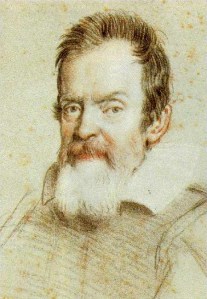
Galilee

Galileo Galilei, 1564 – 1642

So we began with Galileo.

For more than 2000 years before him, I reminded the group, from the ancient Greeks and Romans on through the Middle Ages, natural philosophers had used their vaunted power of reason to generate universal principles. As a kind of afterthought, they would sometimes seek to demonstrate these principles by way of experiment.

Galileo respected this more traditional, deductive approach to science.

But he also employed a new approach.

Namely, Galileo began to perform experiments and collect data first, and from these experiments he would derive a universal principle – which he would then confirm by way of reason.

Put this way, this is only a difference in the order of steps, right?

Reason → Experiment

vs.

Experiment → Reason

So what?

In fact, as we all know, this change would have profound ramifications for the world.

For experimental data come directly from nature (and not from the error-ridden presuppositions of the mind).

Data are accessible to anyone.

Data cannot be imposed from above. Data may surprise and astonish and offend, and they are not afraid.
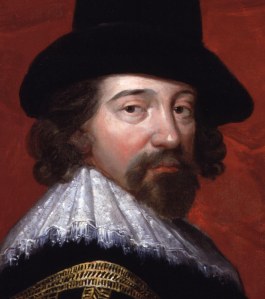
francis_bacon

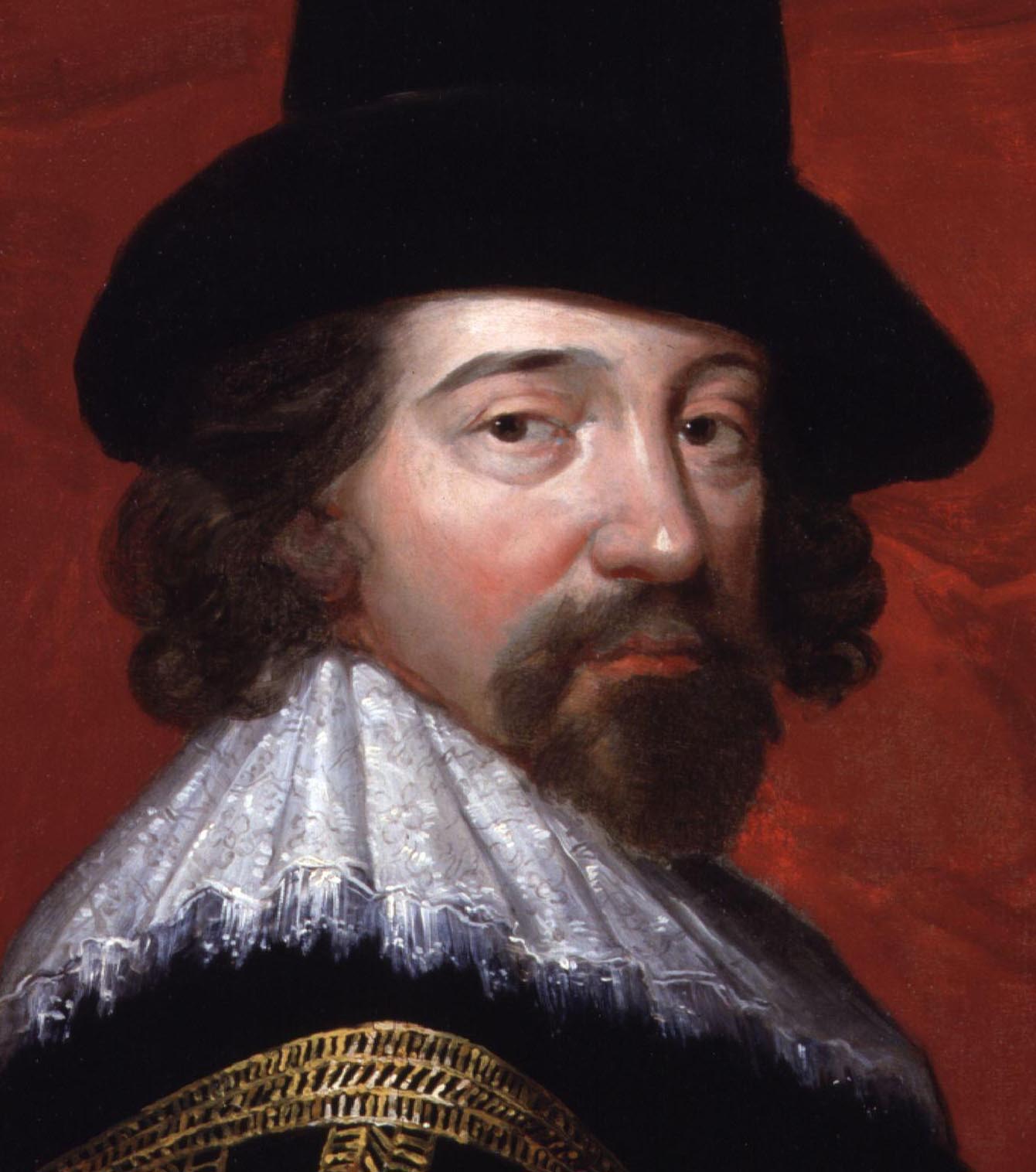
Francis Bacon, 1561 – 1626

In this way, Galileo inaugurated a new era in thinking, by his use of mathematics and thought experiments (and even a few hands-on experiments) as a way to investigate the world.

Francis Bacon did something important too. He was the first to attempt to articulate, in a cohesive fashion, what we recognize today as “the scientific method.”

A contemporary of Galileo, Bacon was not a scientist, but rather he was… a lawyer. His importance to the development of the scientific method lies, accordingly, not in any of his discoveries, but in the way that he formulated a new approach to inquiry.

Bacon advocated starting with nature, and generating exhaustive lists of observable facts, or “histories,” not unlike someone preparing a case for court.

Based on these histories, he argued, certain questions could be framed, and – importantly — experiments conducted, from which conclusions about the world might be drawn. Bacon’s approach is one of induction (as opposed to deduction), trying to understand nature from the bottom up, as it were.

It turns out that Bacon had a big influence on the course of science, and much of it after his death.

4309

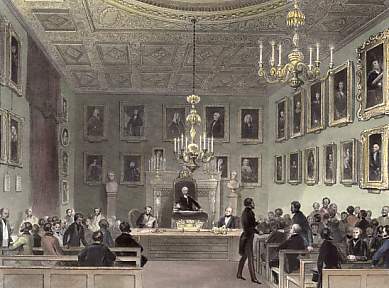
A meeting at the Royal Society, Somerset House, London, 1843

He died in 1629. But in 1662 a group of his admirers formed the Royal Society, with the explicit goal of advancing Baconian principles. And over the centuries that followed, the Royal Society proved to be a formidable engine of scientific discovery. It was, for example, the venue that fostered Darwin’s On the Origin of Species, more than two hundred years after its founding.

2. Tom’s Presentation: Are the Values of Science All We Need?

Okay.

Overview of the readings done.

At this point I pivoted to make a more personal point.

Why did I want us to read on Galileo and Bacon, anyway? I explained to the group that, to my mind at least, this is not dry, dusty history at all.

I have the strong sense that the underlying values of science, so long obscured to the public by the productions of science, are now, some 400 years later, more important than ever.

For many years, I pointed out, science has meant… stuff. The steam engine, the cotton gin, chloroform, the screw propeller, the telegraph, the telephone, the machine gun, the airplane, central heating, penicillin, nuclear fission, the computer — you name it, the changes wrought on our lives have been overwhelming.

As a result, science has been (and to a large extent, remains) synonymous, in many people’s minds, with technology. Out of a sense of caution, people have kept everything personal and emotional and sacred in their lives away from it. They have the reasonable urge to protect those things that they associate with deeper meaning from these baffling technological changes. (See C.P. Snow’s famous 1959 essay, The Two Cultures and the Scientific Revolution for a discussion of the division between science and the humanities that runs through our education system as well.)

But now something new, something big, is happening, I think.

And we are lucky enough to be alive to witness it.

After some 400+ years, the saturation of science into our world has reached the point that even non-scientists are beginning to grasp the value of the scientific method as more than… stuff, but a meaningful perspective on life itself.

*

When you think about it, in fact, the values of science are pretty much exhaustive of the values of a well-lived life.

I mean, let’s consider the threshold requirements for doing science…

Everyone is equally welcome.

Doubt everything.

Tell the truth.

Rely on evidence whenever possible.

Use parsimony (Occam’s razor) to distinguish between contrasting interpretations.

Accept the demand of verifiability (or more accurately, falsifiability).

Insist on public confirmation of private results (submit to peer review).

Feel comfortable with uncertainty.

These, I would suggest, are not merely a batch of coherent values – they are exactly the values we need for a good life! They pretty much will do it for us, if we are willing to live by them.

Oh — except they leave out one, perhaps the most important: love.

Which, I suggested, we can add, like so much gold dust, sprinkling it over the top of the others…

163818505165171278_hEyaE3QR_c-1

Doubt. Parsimony. Truth-telling. Turning to evidence.

And…

Love.

What more do we need?

Nadine spoke up first to say that the scientific method reminded her of how children play.

They explore first, without taking a principled approach or even making a hypothesis. They bend an object, twist it, taste it, bite it, and so on — until it breaks. So perhaps the inductive, bottom-up method behind science is innate in us, and it has only been blocked for so many millennia because of pre-conceived notions (which adults make up and force upon their children)?

Don suggested that, perhaps, until recently we were ill-equipped cognitively to apply ourselves in the rigorous, doubting, highly attentive manner that science requires. He referenced research (Don — can you give us a name of the study?) on the toll that our poor diet took on our capacity to engage in the processes of higher reasoning. “When all you are eating are stems and roots,” Don said, “You can’t do much more than get through the day.”

Ken brought up the work of the philosopher of science Thomas Kuhn to call into question the idea that the underlying values of science are so important and effective after all. Kuhn famously argued in his work, The Structure of Scientific Revolutions, published in 1962, that progress in science is not as open-ended and driven by discovery as we imagine it. Instead, as Ken explained to the group, Kuhn details how the prevailing paradigms in each scientific field are highly rigid — and consensus is strictly enforced by scientists upon one another. A culture of groupthink prevails right up to the moment when the data contradicting this paradigm (let’s say the classical mechanics of Isaac Newton) make it no longer defensible, at which point the paradigm shatters and someone else picks up the pieces to build a new paradigm (e.g. Einstein’s Special Theory of Relativity). If Kuhn’s theory is true, Ken suggested, then it should cast doubt on the idea that humans are engaged in some high-minded pursuit of truth by way of the scientific method.

Setenay also mentioned that there are always questions of resource distribution, exclusion of unwanted groups, academic politics, flawed assumptions in basic models, and many other factors that make science less of a pure, universally accessible, truth-seeking enterprise than my remarks might suggest. “Pure science,” she offered, “may incorporate many of these great values you mentioned, Tom. But very few scientists, in my field of environmental engineering, for example, practice this kind of pure science. A whole slew of personal, social, economic and even political considerations inevitably enter into our work, our projects, even into our models and interpretations of data.”

Anne, who is a science journalist, gave a rousing defense of the ideal of science, saying that despite corruption and bias she believes that science does prevail in the end. And if you are rejected from one journal, or squelched in one area of research by the prevailing “paradigm,” there will be other journals, other resources, over time. Truth will out. The scientific method prevails.

3. Is Science More Open to ‘Miracles’ Than Religion?

I was with Anne. While fully admitting that my view of science is romantic (I see science through the rose-tinted spectacles of someone who reads about it, but doesn’t do it), I felt compelled to defend it too.

In my attempt to do so, I presented the following “thought experiment.”

With as much drama as I could muster, I began…

“If Jesus of Nazareth were to descend from the ceiling, this moment, and hover a few inches above this… this… dias…” (I was pointing to a small, circular coffee table, marred by stains from years of tea mugs) “…what would we do?”
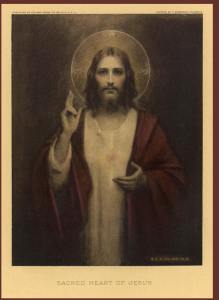
jesus-nazareth-600

Yep. This guy.
In mid-air above the coffee table.

My voice began to quiver with ersatz rapture as I continued…

“You see the light, streaming from His head. The white robe, rippling around Him… He gazes at us with fierce eyes…

“I have no doubt — do you? — that we would be open to accepting Him, despite not being religious!

And here’s why: after we got over our initial shock, we would receive this visitation of Jesus of Nazareth as observable data, just like all the rest of the data in our lives. Considering how remarkable this vision was, we would, of course, be absolutely curious to know more about it! We would want to examine it in all its particulars, have teams of scientists conduct studies on it, converse with it (if possible!), record the event on HD video, etc.

“Once we had managed to establish that there were no hidden projectors or magicians tricks involved (in other words, once we had assured ourselves that it was based on evidence; could not be falsified; that there was no more parsimonious explanation available; etc.), we would be happy to consider the possibility that Jesus of Nazareth’s Second Coming really happened in a living room in Berkeley, California, at a meeting of the Old New Way, in the year 2015.”

(Most of us anyway. Maybe Dean would be a hold-out?)

“For something would have changed our (scientific and therefore always provisional) worldview: the arrival of the convincing sense-data of a floating figure in our midst, a creature previously unrecorded in the annals of science!

“The appearance of Jesus, in this case, would not represent a miracle; we would not be succumbing to a religious point of view. On the contrary, it would represent a fact!” (Mind you, this would take multiple, double-blind studies on the phenomenon, peer-reviewed in respectable journals, before we could call it, even colloquially, a scientific “fact”. With that we are with you, Dean.)

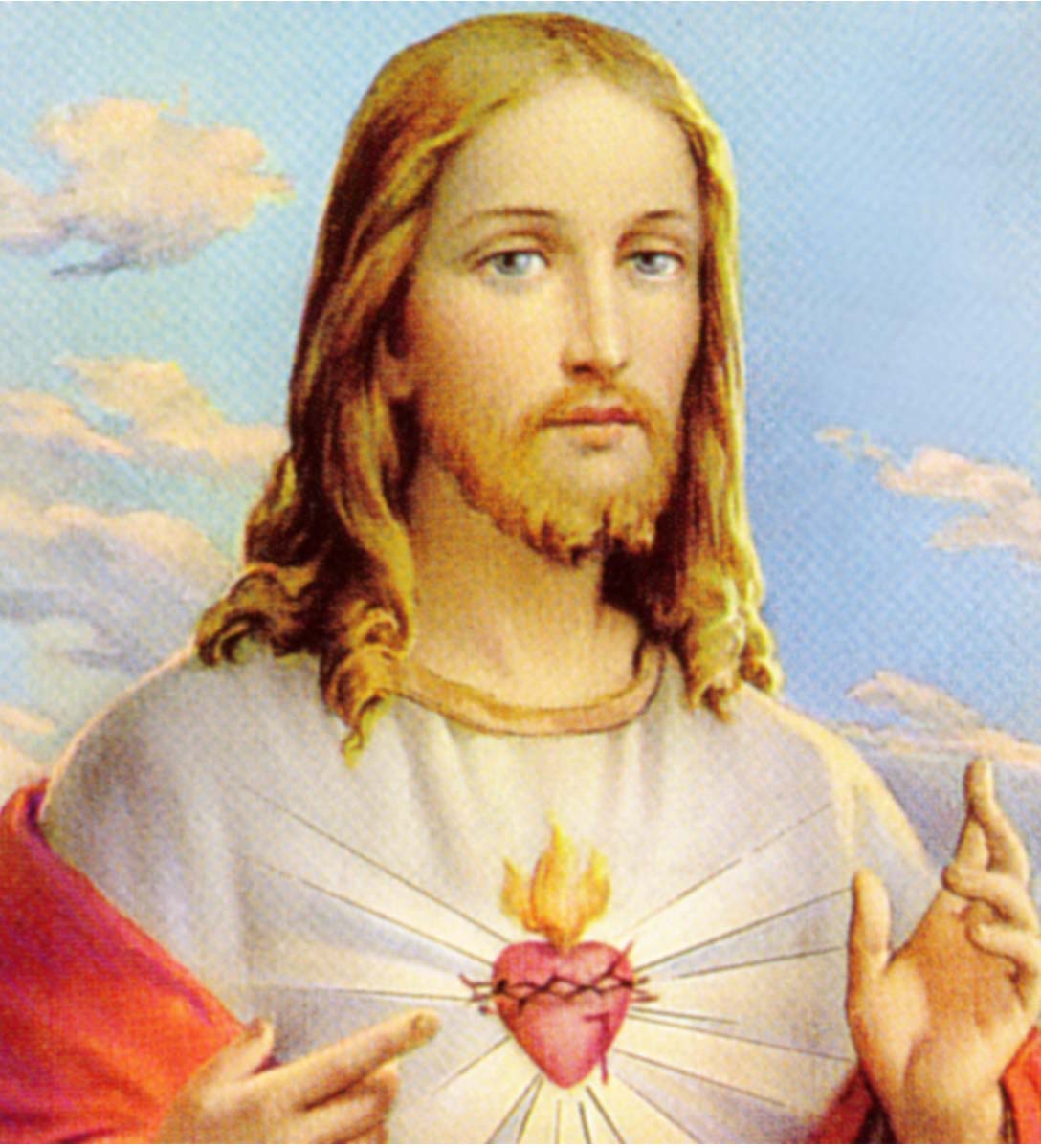
“And here’s what is really interesting, I think. I am convinced that a group of religious people would be more likely to look aghast at this apparition, run away, scream, curse it as the work of the Devil, than us scientific-minded folk. Okay, okay, maybe if this Jesus just so happened to act and look precisely in the manner that they expected then they would accept Him faster even than us. (Surely most evangelical Christians in the U.S. would accept that fair-skinned, blue-eyed, goldilocked guy we all know so well with minimal friction.)

zsacredheartofjesus01x1200

“But if he did not match their preconceived picture, I think that this floating figure would be seen as a terror, a threat. I suspect that their lack of curiosity about the material world, their lack of familiarity with the inductive approach of Bacon et al. would hamper them from exploring the particulars of this event standing before them. Indeed, they might face a kind of psychological paralysis, or traumatic event, considering that their private certainties would be overturned. Jesus is not supposed to look like this! Jesus would not appear now, here, in this random living room in Tom and Renée’s house on a Thursday night! I didn’t imagine it this way.”

When I was done, Renée spoke up to say that this “thought experiment, whatever it was,” struck her as… “not useful.” She wanted to move on.

Taken aback by her vehemence, I briefly made an effort to explain why I had brought it up:

“But, but — what I’m just trying to say is that those who have absorbed the values of science are actually more open to facts in the world, even including seeming ‘miracles,’ than religious people!”

But it wasn’t working. She gave me a look as if to say, “Are we done?” So we moved on.

4. Dean’s Assertion of Scientific Facts — and His Frustration with the “F-ing Idiots” Who Refuse to Accept Them 

At this point Dean could no longer contain himself.

He argued that it was all well and good to admire the values of science, the doubt, the provisional nature of its findings, and so on.

But there are certain findings that are really irrefutable and should not be questioned. Scientists are their own worst enemies when they constantly talk in a muddled way about the uncertain and provisional nature of scientific facts, because it feeds the idiocy of the deniers and nuts who subscribe to mystical and religious pabulum of all kinds.

“The universe began approximately 13 and a half billion years ago. Period,” Dean stated. “It started with the Big Bang. If you deny these facts, then you are a fool. So my question is: what should we do when we encounter people who live with a completely different worldview which denies the scientific consensus on things like this? Or even worse, when they deny things with direct consequences… like, say, the relationship between the release of carbon into the earth’s atmosphere and climate change? What do we do, ignore them? Try to convince them? I want to put that out there for the group to answer.”

Heather argued that we would not be able to convince them because their “attachments” align them otherwise. Their emotional and personal needs position them on the other side of the science community in these cases, and therefore they select only those findings that fit with their own narrative.

Yann mentioned a study (click here for the link) in which it was shown that, in the United States at least, it is actually the more highly educated, in areas of the country in which majorities deny the effect of human activity on climate change, who are the most inflexible and adamant in their position. This is counterintuitive, he acknowledged, but it is revealing too. More education, more facts, he said shaking his head, will not sway opinion.

I tried to reframe the argument — as a way of answering Dean’s question of what we can do when faced with such obstinacy. As Heather and Yann are suggesting, I agreed, we can’t meet their certainty with our certainty and have any hope to convince them.  They have a narrative in their heads about God’s glorious plan for the earth. And our own certainty about the damage being inflicted on the planet by the burning of fossil fuels isn’t going to change that one bit. That kind of approach is a losing battle from the beginning. And we will lose it every time, I argued, because with Dean’s approach we have already ceded to them the frame in which we are talking!

When you meet one certainty with another certainty, you are tacitly accepting a quasi-religious claim to what knowledge is.

Instead, I argued, we have to get it through their heads that there is no capital-T Truth, and none of us will ever have certainty. There is only evidence… probability… and yes, degrees of consensus, which in the case of scientific inquiry really means nothing more than “the consensus of a many people who have looked carefully at this question and checked their work against one another’s.”

We have to ask them: what’s your method? Private revelation? Appeal to authority? We have to get them to try to defend their method against ours, and insist that ours is more public, more open-ended, and ultimately more humble.

Dean is concerned that we weaken our argument by resorting to talking about the preponderance of the data and provisional claims — that is, when we use the language of science. Yet I would argue that we should actually double-down on this kind of talk! We need to insist that our claims for, say, the age of the universe or the danger of carbon emissions in the atmosphere ARE provisional and uncertain, but they are also THE BEST HUMANITY CAN CURRENTLY DO.

In fact, seen this way, our framework, the scientific worldview, encompasses theirs (all of their talk of God’s glorious plans and the Garden of Eden, etc., are equally viable as research subjects, just as much as anything else). All we are saying is that if you can convince others who are willing to check your facts and your reasoning, then even your religious-infused interpretation of the temperature trends of the planet has a fair shot! But you can’t refuse to subject your judgments to scrutiny, and then turn around and say that all those interpretations and judgments which have been subjected to scrutiny are no more valid than yours.

Nadine brought up, in this context, her concern that ultimately those of us who are not scientists (or even if scientists, are not specialists in the field in question), are compelled to take much of what we read on “trust” — or even, dare we say it, “faith.” So what is the difference, she asked, between the faith of the religious person and the faith of those who are willing to accept scientific findings?

Luis pointed out that the difference is one of willingness to revise if necessary. The person who accepts the age of the universe to be 13.798 billion years old because he or she understands that it is the scientific consensus (based on measurements of electromagnetic waves, “red-shift” etc.), will be willing to revise this to 14 billion years, or even, hell, one day, if the scientific consensus shifts accordingly. We are admitting the possibility of error. So our “trust” or “faith” is in a method, not in a particular answer.

I was tempted to bring back the Second-Coming-of-Jesus thought experiment here, to illustrate once again the willingness of scientific-minded to admit error. But one glance at my wife and I knew better.

5. Do the Monsters Unleashed by Science Rightly Undermine Its Appeal?

At this point we branched into a different discussion.

I felt it was important to acknowledge the serious costs inflicted on humanity and the earth by technology, which is, after all, made possible by scientific method. We can praise the underlying values of science all we want, and perhaps they have done much good (particularly in the fields of health and agriculture). But then we have the threat of nuclear extinction, a planet which may be heated beyond what is sustainable for human life, the acidification of the oceans, and so on. Don’t the various productions of science discredit the whole project?

My own answer to this was that you don’t reject love entirely, just because of the harm done in some cases by… divorce. There are bad consequences of some good things, but those consequences can and must be distinguished from the thing itself. (Marie-José, having no idea what I was talking about, heckled me from her position on the other side of the room, “Love makes divorce? What?”)

Yann was more hopeful that the monsters will be managed. He spoke of an “arc” of progress, which has been demonstrated in many fields, according to which a new practice or method “self-corrects” itself over time. (I would like to see some study on this, Yann — please send us a link.) If he is right, then not only can we distinguish the good of science from its more unfortunate productions, but we can expect science to get it right over time and reduce the number of errors it makes along the way. Though Yann admitted that there is a risk that it won’t self-correct in time, and we will face extinction.

Heather sighed somewhere in this discussion, “Oh, I have had about enough of this…” (She can’t stand talk of extinction, annihilation, apocalypse.)

6. Where Love Fits In With Science

We had fallen into the trap, so common in our culture, of discussing the values of science merely in terms of the effects of science. As if science must be cordoned off to its own sphere.

So, as it was getting late, I steered the group back to the conversation that we had at the beginning of the meeting. Do scientific values apply to other aspects of our lives? Should they?

Marie-José spoke up to say that she felt science may be able to describe the biological and chemical processes of love, but it can never capture the actual experience of it. Therefore it doesn’t satisfy as a worldview — we need poetry and music and other unquantifiable depictions of first-person experiences to guide us too.

Dean said that he believed that all of it is measurable and quantifiable — even our love for our children, which can be reduced to an evolutionary impulse to protect our DNA.  And yet this still leaves us feeling these things. Science does not drain life of meaning because of its descriptive and explanatory power.

Heather offered her view that we need illusions. That the raw and ugly truth offered by an exclusively scientific outlook would be too bleak. (She was still recovering from all that talk of annihilation and extinction.)

I countered Heather’s point to say that I did not think that truth, when exposed, is necessarily raw and ugly. Her comment reminded me of my problem with John Gray’s book The Silence of Animals, an excerpt from which we read for the meeting. Gray suggests that scientists and liberals generally are trapped in a myth of human “progress,” and that without this myth we would be bereft. As I read him I kept thinking, “No. Not true.”

I don’t have any conviction, any myth, of progress! (Do you?) I see us as animals, with a  drive for consumption and even hoarding of energy and resources. Our intellectual capacities are no doubt fascinating, but limited. In the end, we may very well sabotage the only planet we inhabit (as Dean memorably put it, humans ‘shit in their own soup and eat it, again and again!’).  Yet I’m not bereft. To my way of thinking, the lack of absolute meaning does not lead to a nihilistic worldview. When you let go of your myths you soon come to terms with all the changeable, small meanings in your life, and you get quite attached to them without making a myth out of them.

But the point of Marie-José that love’s subjective experience lies outside the reach of science did resonate with me, I added. I had talked at the start of the meeting about sprinkling the values of science with the “gold dust” of love — but what if this is a combination that just doesn’t mix well?

How do we mix the third-person “objectivity” of science with our first-person subjectivity? How do we know when to move from one habit to another? What’s the trigger, for example, during an argument with a friend, that we might use to move from our impartial assessment of the evidence and the application of the rule of parsimony (in scientific values mode with him)… to a decision to simply, silently, hear our friend’s hurt, not with the aim of recording it as data but instead just hearing it (love mode)? How can science tell us when to make that switch in our approach?

7. Wrap-Up

Close to the end of the meeting Gerry shared his own experience as a cardiologist, circling back to the skeptical view of the scientific method. Although he recognizes the great achievements of science (after all, the entirety of his work is based on them), he has also seen over the years how much the scientific consensus is shaped by distortions in the health care market, by the whims of editors in scholarly journals, by trends in the field. He has learned to adapt to the point that five years from now he expects to be doing very different things than he does now, some of them in direct opposition to current practices. That was a useful cautionary note from the field.

Luis mentioned that famous quote from Winston Churchill: “Democracy is the worst form of government, except for all the others.” He said that he thinks of the scientific method along these same lines: flawed, but the best we have.

By the end of the meeting I, for one, realized that we have a long way to go before we determine that the values of science are all we need for a good life.

They are surely valuable (I’m still enamored of them!), but perhaps they are more applicable to social, external, even political settings? Perhaps at our more private and internal moments we need another source of guidance?

Interesting, that back in November we found Epicurus to be too individualistic in his philosophy. For example, he struck us as too focused on the insubstantiality of his own death while not acknowledging the enormous suffering and loss that his death might cause in the lives of others (and, similarly, the suffering and loss that the death of friends might cause in his life). And here in our next discussion we find science to be perhaps too outward-looking in its outlook! It looks to public confirmation, evidence, verifiability, but it leaves out the subjective and unique experience of each person.

Onward. More investigating to do in the months ahead.

It is such an honor to be part of this open and searching (and loving, gold dust and all!) group.

See you in February.

More on Values and Science

TUESDAY, FEBRUARY 3, 2015

For almost 300 years now, one of the most widely shared understandings in philosophy has been the distinction between facts and values.

That is, you can’t logically make the leap from a description of the world as it is…

Look, cows in a green field!

to a prescription for a certain relationship between us and that world…

Cows in a green field are good!

Cows-in-field-11

Citing David Hume, philosophers will often speak of the is-ought distinction (aka “Hume’s guillotine”).

But like most widely shared understandings of our species… this one is breaking down over time.

Aided by neuroscience and other advances, every day we are learning more about the brain and its relationship to our lived experience. And as we do, we can actually see that some courses of action, some facts in the world, lead to outcomes that most human beings would prefer (if given the choice). Whereas others lead to outcomes that most human beings would reject — for example, behavior which causes a surge in cortisol, which in turn leads to persistent feelings of anxiety and agitation.

In other words, at the level of biology we are finding descriptive statements blurring with prescriptive statements, and vice versa. For example:

 1. You talk to your child rather than spank him.

2 Your child’s limbic system handles conflict without triggering aggression.

3. A lack of unnecessary aggression makes your child (and you!) happier.

Where, in these three statements, did we move from mere facts to values? But we did, didn’t we?

An article I read recently discusses this question — in regards to spanking specifically. Check it out.

I may be wrong, but I have the impression that the author may not realize just how deeply subversive his piece is. For really, how far does it go? You can start with spanking, but you might end up with… what? …a Universal Bill of Rights for Children, saying that some cultures around the world have it right and others wrong? The science isn’t there yet — but in theory it could be, no?

Will science someday be able to tell us whether, in fact, cows in a green field are good? (After all, the question is, ultimately, “How do cows in a green field affect our brains, to our advantage or disadvantage?” And this is, in theory, measurable!)

Two books address this breakdown of Hume’s is-ought distinction more generally:

The Moral Landscape by Sam Harris, and

The Moral Arc: How Science and Reason Lead Humanity Toward Truth, Justice and Freedom by Michael Shermer (very recently published — I haven’t read this one yet).

Next month, when we look at the Enlightenment and its dream of “progress,” we will explore some of the strongest critiques of this way of thinking. For of course there is a downside to seeing values as facts. In the last 100 years we learned that all too well from watching the overreach of fanatics like the Nazis and ISIS.

Is there a way around this danger? Are values that are confirmed as facts by science safer than other values? Or is it useful to keep the is-ought distinction, just to keep us doubting ourselves, even if the invention of the functional MRI has made it a relic?

Perspectives on Changing Minds on Science and Religion in the U.S.

FRIDAY, FEBRUARY 6, 2015

by Luis

In our meeting last week, Yann described the paradox observed in the US wherein many political conservatives combine good knowledge of science with completely non-scientific opinions on certain ‘sensitive’ topics. I wanted to know more so via Google I found this sociological study, published precisely on the day of our meeting, on the “perspectives on science and religion in the U.S.”

This article seems to have drawn quite a lot of attention from the media (example here), mainly because of the identification of that paradoxical group, which the authors call “post-secularists”.

I read the article in full and realized that its results are actually quite richer, and can provide insights about how to promote a more scientific mindset in the U.S. I am sending you my observations with you in case you want to share them in your blog.

First of all, the authors identify three groups in the U.S. population based on their attitudes towards science and towards religion. They have called them “traditional”, “moderns” and “post-secularists”. “Post-secularists” are “religious and scientifically literate”. These guys score relatively well in non-controversial scientific questions (e.g. the temperature of the center of the Earth or how to design experiments) but overwhelmingly reject the notion of Big Bang (94% against) or human evolution (97% against). Half of them define themselves as “conservative Protestants” and 84% of them are “non-Latino whites”. They mostly oppose abortion and are slightly more numerous in the South. The study doesn’t say it but it’s not hard to guess what news channel they watch and what party they vote for. I suspect that any debate with such people regarding their ‘touchy’ topics is doomed to fail: they simply refuse to believe anything that contradicts their “superior source of truth”. If the Bible says the Earth is flat, then the Earth is flat and that’s it. Fortunately for us, “post-secularists” are a minority only represent 21% of the US population today.

The group of “traditionals” (i.e. religious and non-scientific) is double the size, at 43% of the population. These folks mostly deny Big Bang too (79%) but they also ignore the existence of natural radioactivity (53%) or that electrons are smaller than atoms (64%). Almost half of them (46%) actually think that the Sun turns around the Earth! They say they are quite religious but nowhere close to the fanaticism of the post-secularists. “Traditionals” are the most racially diverse group: only half of them are non-Latino whites. More than 70% of African-Americans and Latinos are classified here. “Traditionals” rank substantially lower in income and years of education than “moderns” or “post-secularists”, and 60% of them are women. All this actually gives me hope because I tend to think that, with better education and access to science, many “traditionals” could eventually become “moderns” (i.e. those who prefer science to religion as source of ‘truth’). They don’t refuse science because of religion, they just have no idea of what science is or says. Campaigners for science should therefore target minority girls and poor neighborhoods, and make sure that their message is available in Spanish.

Finally, the “moderns” are those who score well in all scientific questions even if they contradict conservative Christian beliefs. This group represents around 36% of the US population, is overwhelmingly White (88%), and slightly more liberal and more male (58%) than average. This is the only group that strongly supports the unconditional right to abortion. Interestingly, atheists/agnostics tend to be classified here but they remain a minority even within this group: only 36%, versus 19% in the overall population. That means that almost two thirds of the “moderns” seem to be able to reconcile their religious affiliation or spirituality with a scientific view of nature. This is another piece of good news for me (even if I am an atheist) because it means that supporters of science need not destroy religiosity in order to impose their views. I suspect that would be doomed to failure anyway, since spirituality is an innate human intuition and feeling. A balance can seemingly be found where scientific mindset and a certain level of spirituality can coexist.

Summing up, if I had to devise a strategy to give science a more prominent role in U.S. minds, I would do the following: 1) promote education and access to science among the poorer communities, especially African-American and Latino; 2) allow religions and spirituality to slowly move their focus to realms beyond the current borders of science, those areas where the scientific method has not yet made many inroads; 3) not waste time trying to persuade the educated religious fanatics, who actively refuse to even challenge their beliefs, but expose and counter their propaganda whenever necessary.

Link to download the original study:

Click to access Feb15ASRFeature2.pdf

Commentary in The Huffington Post: http://www.huffingtonpost.com/2015/01/29/post-secular-evolution_n_6571154.html

On “Building Better Secularists”

FRIDAY, FEBRUARY 6, 2015

In an opinion piece in the New York Times a couple of days ago, the conservative commentator David Brooks wrote of the various challenges arrayed against those of us who choose to live our lives outside of organized religion.

We have a huge mountain to climb, in Mr. Brooks’ estimation.

Nez-Perce-mountain

First, we must construct a personal moral philosophy, all of our own.

Second, we must build communities to support us — and build them from scratch!

Third, we must set aside — and even more difficult, we must keep — a regular time for reflection (in his words, a “Sabbath”).

Finally, we have to find the “moral motivation” to care.

Consistent with the familiar, benevolent, “Who me?” pose of David Brooks, his piece makes every effort to sound fair (“The point is not that secular people should become religious,” etc.). But the impression is leaves is unmistakable…

Why would you do this to yourselves?

Just go with a ready-made religion already!

Choose one, any one, doesn’t matter.

In today’s paper, there were some useful responses from non-believers, questioning some of the premises of his argument.

I have just one response to Mr. Brooks myself. I would suggest that he has left out our biggest advantage over the religious…

The truth.

That’s the crux of the matter, isn’t it?

That’s our base camp.

Let’s keep climbing.

Reading for the Fifth Meeting — THE ENLIGHTENMENT

THURSDAY, FEBRUARY 12, 2015

What do you see when you think of the Enlightenment?

For me, the word — capitalized so grandly — brings to mind a pleasing scene of a group of philosophes sitting outside a Parisian café in the sun.

Their wigs, of various hues, shine in the bright light.

They gesticulate wildly, laugh, slap one another on the backs, raise glasses of wine high, all the while dreaming up a new world.

I can see just see them, can’t you? Slender Voltaire with his wry smile…

voltaire

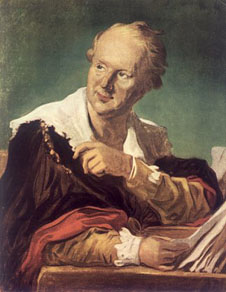
Open-faced, balding Diderot, who tapped the intellects of his age to produce his great Encyclopédie

diderot-3-sized

I see the incomparable Montesquieu writing The Spirit of the Laws, and so founding the science of anthropology. I see La Mettrie, penning Man a Machine, and so founding the science of neurobiology.

Then my mind leaps to England and Scotland, and I think of John Locke with his clear prose and unforgettable nose…

20121115_johnlocke

I think of the “Scottish Enlightenment” — which has been the most long-lasting — and, at the center of it, the great, fat genius of empiricism (and the philosopher who had the most profound impact on me when I read him at Oxford), David Hume. With his admirer and fellow empiricist Adam Smith not far off, tossing a silver coin in the air.

In literature I think of Swift, Pope, Laurence Stern.

And as an American I can’t leave out Franklin, Jefferson, Madison, Hamilton, the Federalist papers. For the Constitution was truly a product of the Enlightenment. It’s not only a work of brilliant political philosophy (influenced heavily by Locke and Montesquieu), but it’s a hands-on blueprint for the longest lasting experiment in representative government the world has ever known.

What images come to mind for you?

*

Rising above individuals now… to a higher level of abstraction… I see the light of Reason penetrating everything.

The world, opening up to human beings in a new way.

Now it can be examined naturalistically, through science and rationality.

Universal values emerge. Human rights. The abolition of slavery. Women’s rights. The shackles of religion, racism, dogmas of all kinds… finally thrown off!

Free now, to stand on our own feet, to use our own perception, our own minds.

1000509261001_1090104754001_Biography-Benjamin-Franklin-LF-Part1

Benjamin Franklin, braving a lightening storm to bring us light.

That all sounds good, no?

*

But there is another side to the Enlightnment, of course. (Some of you might have gotten there already as I was busy singing its praises?)

Western-centric.

Elevating “reason” at the expense of emotion.

Impersonal.

Technocratic.

Giving birth to false utopias.

Advancing a cult of “objectivity.”

A dangerous ideology to support the Powers that Be.

Sweet-talking its way to Colonial rule over “primitive” peoples.

Destructive of the old, the intuitive, the unique, the weird, the wonderful, the intuitive, the paradoxical, the inexplicable.

Oh, and despite its claims of turning to nature… quite severed from the natural world.

In short, a dream turned nightmare.

*

I propose that we tackle this question head-on, don’t you?

Where do you stand? Where do you come out? What is the right use of reason? What threat do you think it poses?

Here are this month’s readings, for your consideration:

I thought we should start with two luminaries of the Enlightenment, as they explore the interaction of European values with other cultures, other lands. In this light (so to speak), I encourage you to read:

1. Denis Diderot’s Supplement to Bougainville’s ‘Voyage’ (click the title for the pdf), and

2. Voltaire’s Candide (you can find a copy, right?)

Both of these works can easily be found online in their French originals.

After that, we are going to turn our attention to the other side of the equation — that is, to critiques of the Enlightenment.

3. Isaiah Berlin, “The Counter-Enlightenment” from Against the Current.

4. Isaiah Berlin again, this time an excerpt from “The Decline of Utopian Ideas in the West” from The Crooked Timber of Humanity.

5. Excerpts from The Disenchantment of Secular Discourse by Steven D. Smith.

Again, you can click directly on the titles of all except Candide to get the pdfs.

Let me know if you have any trouble.

*

Remember, make it personal as you read.

And as always, please feel free to write in with other suggestions or questions or comments.

Happy reading and reflecting. See you on the 5th!